
For most home cooks, a mortar and pestle is the better first tool, and an electric spice grinder is the right second one. The mortar crushes whole spices instead of slicing them, so you get a more aromatic result, control over texture, and the ability to turn garlic, chiles and herbs into pastes. The grinder wins when you need a fine powder, a big batch, or a quick job on a weeknight. Restaurant-style dishes ask for both kinds of work, so the real question is which job is in front of you.
TL;DR
- A mortar and pestle crushes and shears spices, which suits small amounts, coarse or cracked textures, and wet pastes like curry bases, salsa and pesto.
- An electric spice grinder is faster and gives a finer powder, so it suits larger quantities of dry, hard spices.
- The biggest flavor gain comes from toasting whole spices and grinding them fresh, whichever tool you use.
- If you buy one tool, start with a heavy granite mortar; add a grinder kept only for spices when batch cooking becomes routine.
- Never share a grinder between coffee and spices unless you clean it thoroughly, or the flavors cross over.
Table of Contents
- What each tool actually does to a spice
- Spice grinder vs. mortar and pestle, side by side
- When the mortar and pestle is the right call
- When the spice grinder wins
- Why restaurant-style cooking benefits from both
- How to grind spices well, whichever tool you choose
- Keep coffee and spice flavors apart
- Which should you buy first?
- Cook it with the right tools
- FAQ
- Sources
What each tool actually does to a spice
A whole spice is a tiny package of aromatic oil held inside cell walls. How you break that package decides what ends up in your pot.
An electric spice grinder is a blade mill. A spinning blade chops the spice into smaller and smaller pieces at high speed. It is fast and tidy, and it can turn a handful of cumin seeds into powder in seconds. The trade-off is friction: a blade running for a long time warms the spice, and warmth is the enemy of delicate aroma.
A mortar and pestle works by pounding and grinding. A heavy bowl holds the spice while the pestle crushes it against the stone and then rubs it into smaller particles. Many cooks and test kitchens credit this crushing action with releasing more of a spice's aromatic oils than blades do, and you can feel it happen: the fragrance rises as you work. Good Housekeeping describes the tool as a heavy bowl and matching grinder that crushes, giving more texture control than a food processor or spice grinder.
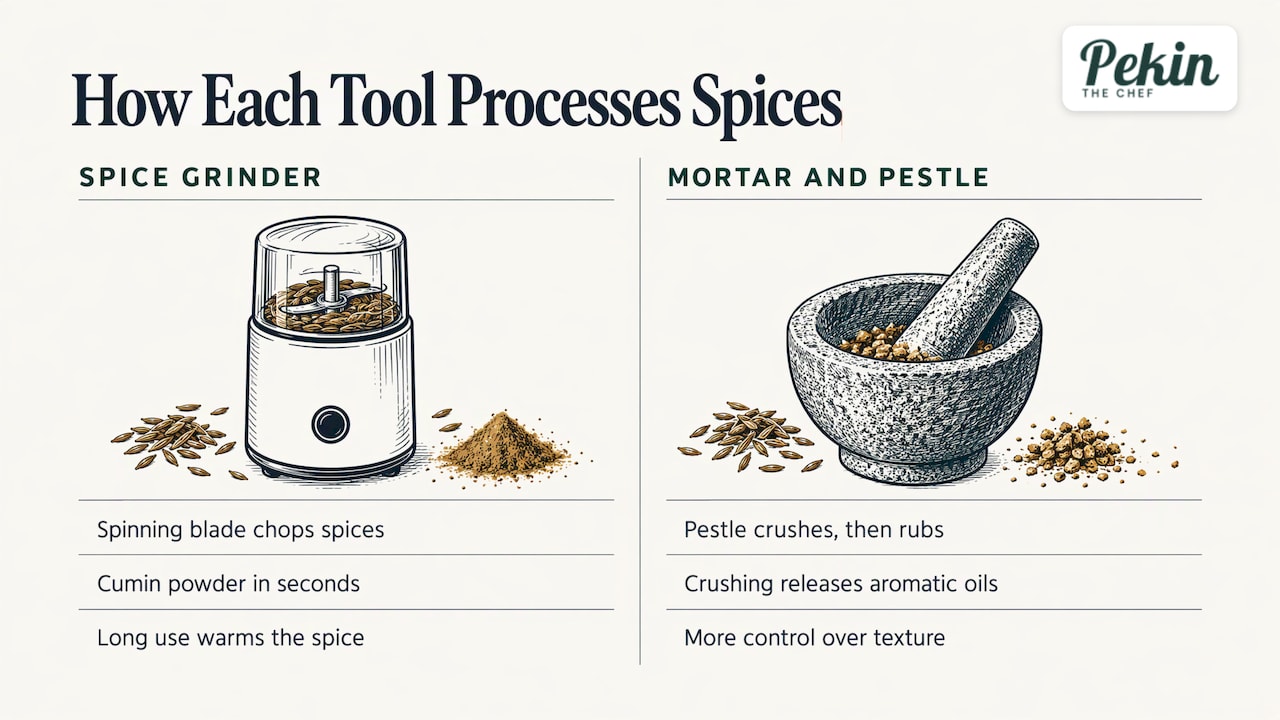
So the two tools are not the same thing in different shapes. One cuts, the other crushes. That single difference explains almost everything in the comparison below.
Spice grinder vs. mortar and pestle, side by side
| What matters | Mortar and pestle | Electric spice grinder |
|---|---|---|
| Aroma | Crushing releases a lot of fragrant oil as you work | Good when ground fresh; blades can warm the spice if run too long |
| Texture | You decide: cracked, coarse, or fine | Tends toward fine powder, sometimes with a mix of fine and coarse bits |
| Speed | Slower, a few minutes for a small batch | Seconds for most dry spices |
| Effort | Real arm work for hard spices | Press a button |
| Batch size | Best for small, cooking-sized amounts | Best for larger amounts |
| Wet ingredients | Excellent: garlic, ginger, chiles, herbs, pastes | Dry spices only |
| Cleanup | Rinse and dry the bowl | Wipe out; deep cleaning needed to remove oils |
| Lifespan | Stone lasts for decades | Motorized, so it depends on use |
| Noise | Quiet, apart from the pounding | Loud for a few seconds |
None of the rows is a verdict on its own. A cook making a single curry for the family cares about aroma and pastes. A cook prepping a month of spice blends cares about speed and volume.
When the mortar and pestle is the right call
Small amounts, big flavor
Most restaurant-style recipes call for a teaspoon or two of a spice, not a cup. That is exactly the range where a mortar shines. A blade grinder needs a minimum amount of spice to catch the blade properly, so a single teaspoon of coriander can scatter around the jar. In a mortar, a single teaspoon sits right where the pestle can reach it.
Coarse and cracked textures
Some dishes depend on texture. Cracked black pepper on a steak, lightly crushed fennel seed in a sausage rub, bruised cardamom pods in rice: all of these want pieces, not powder. A mortar lets you stop at the exact moment the spice is right. With a grinder, the line between cracked and dust is a fraction of a second.
Pastes, salsas and anything wet
This is the mortar's clearest advantage. Garlic, ginger, fresh chiles, lemongrass, herbs, toasted nuts and salt all break down together, and the crushing action blends their juices and oils into something a blade cannot imitate. Think of a Thai curry paste, a Mexican salsa, a pesto, or a spicy sauce like shata. A grinder simply cannot take wet ingredients.
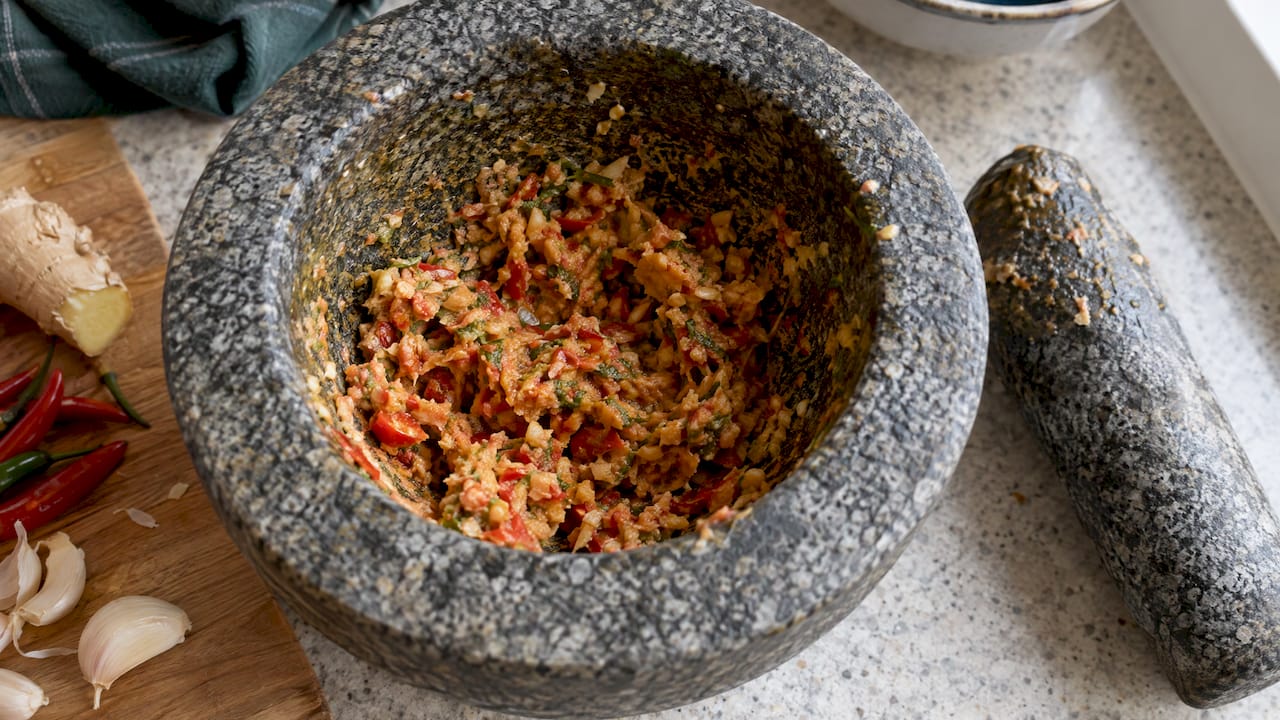
If you want to see where this matters, try a restaurant-inspired recipe built on a paste. Our Massaman curry recipe inspired by Aloha Kitchen is a good example of a dish whose depth starts with well-crushed aromatics, and the extra tahini or shata hot sauce recipe from Aladdin Mediterranean Grill rewards the same patient crushing of chiles and garlic.
Choosing the right mortar
The material matters more than the size. A heavy granite mortar with a slightly rough interior grips the spice as you grind. A smooth bowl lets seeds skitter away and slide up the sides. Yotam Ottolenghi makes the same point in The Guardian, calling a pestle and mortar a great tool, particularly one in granite with some texture, rather than a smooth one. Wood and thin ceramic are better suited to gentle jobs than to hard seeds. Choose a bowl big enough that the spice does not leap out, but not so big that a teaspoon of seeds gets lost in the bottom. Fill it only about a third of the way, so nothing flies out when you pound.
When the spice grinder wins
Fine powder
Hand-grinding hard spices to a truly fine powder is hard work, and it does not always come out evenly no matter how long you go. Ottolenghi says as much: in the same Guardian column he admits that spices do not always come out finely ground by hand, however much elbow grease you apply, and he suggests simply buying a grinder. He also notes that the real value comes from toasting and grinding whole spices like cumin, cinnamon and star anise yourself.
For dry rubs, garam masala, curry powders, or a baked-goods spice blend that needs to dissolve smoothly into a batter, a grinder gets you there without the sore wrist.
Hard, woody spices
Cinnamon bark, star anise, nutmeg, cloves and dried chiles are tough. A mortar will make them cracked and rough, and a grinder will make them powder. If you are working with whole cinnamon, such as true cinnamon, Cinnamomum verum, break the quills into small pieces first and let the grinder do the fibrous work. Even the best mortar struggles with those long, curled sticks.
Batches and routines
If you grind spices every weekend for a week of meal prep, or you make your own spice blends in larger quantities, a grinder saves real time. It also suits cooks with sore hands or limited strength, for whom thirty seconds of pounding every dinner is not a joy.
What the tests say about models
If you are shopping, Good Housekeeping's 2026 Kitchen Awards tested nearly 350 products with more than 600 at-home testers, and it named the FinaMill one-touch electric spice grinder for seasoning large quantities quickly. It has a thick handle, a large button and two swappable containers, which suits a cook who switches between blends. Look for features along those lines: a comfortable grip, a container that is easy to empty, and a design that lets you swap between spice types without a full scrub.
Why restaurant-style cooking benefits from both
Home cooks who chase restaurant flavor often discover that the gap is not a secret ingredient. It is how the spices were prepared. Restaurant kitchens toast whole spices, grind them to order, and match the texture to the dish: a fine powder for a smooth sauce, a coarse crush for a rub, a fragrant paste for a curry base.
That is useful to keep in mind when you read a recipe. If it says "ground cumin," a jar of ready-ground cumin will work, but toasting whole seeds and grinding them just before cooking gives the dish a clearer, warmer, more fragrant flavor. If it says "crushed" or "cracked," reach for the mortar. If it lists a spice blend, grind a larger amount in a grinder and store it in a small jar.
A bulgur or rice dish is a good place to test this. The warm spices in dishes like Aladdin's Restaurant mujadara show their character when the seeds are toasted and freshly crushed, and the difference is easy to taste next to a jar that has been in the cabinet for a year.
How to grind spices well, whichever tool you choose
- Start with whole spices. Cumin, coriander, fennel, peppercorns, cardamom and cloves keep their fragrance far better whole than ground.
- Toast them first. Warm a dry skillet over medium-low heat and shake the spices until they smell nutty and fragrant, usually a minute or two. Pull them off the heat as soon as the aroma blooms, because they burn quickly.
- Cool them completely. Warm spices turn gummy in a grinder and make for sloppy work in a mortar. A minute on a plate is enough.
- Grind in small amounts. In a mortar, fill the bowl about a third full and use a pounding and swirling motion, with firm pressure, until you reach the texture you want. In a grinder, work in short pulses instead of one long run, shaking the jar between pulses so the pieces move around the blade.
- Sift if you need fineness. Shake the grind through a small sieve, and return the coarse bits for another pass.
- Use or store promptly. Ground spices fade faster than whole ones, so grind what the recipe needs, or make a small batch and keep it in a sealed jar away from heat and light.
Keep coffee and spice flavors apart
Many people start by borrowing a coffee grinder for spices, and Ottolenghi himself uses one that was originally bought for coffee. It works, but oils cling to the burrs and blades, and they are hard to remove. A cumin note in your morning espresso is a real risk, and so is coffee in your curry.
The simplest solution is a second grinder, used only for spices. If you must share, clean it carefully between uses; this guide to cleaning a coffee grinder properly walks through the process. For a mortar, rinse with hot water, scrub with a brush, and let it dry fully. Skip soap with unglazed stone, since it can leave a lingering taste, and keep one mortar for pungent garlic and chile pastes if you also grind sweet spices.
Which should you buy first?
Think about what you cook most.
- You cook for a household and like sauces, marinades and curries: a heavy granite mortar and pestle. It handles whole spices, garlic and chiles, and it never needs a battery or a plug.
- You prep spice blends or cook for crowds: an electric grinder reserved for spices.
- You cook seriously and often: both. Use the grinder for powders and bulk work, and the mortar for pastes, cracked textures and the dishes where aroma matters most.
- You mostly want freshly cracked pepper: a pepper mill with an adjustable grind will serve you better than either.
If budget allows only one, the mortar covers more ground in the home kitchen. It makes the widest range of textures, it handles wet and dry ingredients, and it simply lasts. You can add a grinder later when volume becomes the issue.
Cook it with the right tools
The best way to learn the difference between these tools is to cook something that depends on them. Pekin the Chef collects recipes inspired by dishes from real restaurants, with feedback from home cooks, and you can search by restaurant, dish, cuisine, meal type or prep time. Browse the full collection at Pekin the Chef and look for the curries, sauces and spice-forward dishes that ask for fresh grinding. Our recipes link to kitchen tools and ingredients, so you can find the mortar or grinder that fits the dish you have in mind.

If you are comparing other pieces of equipment as you build your kitchen, our guides on immersion blender vs. blender and Instant Pot vs. slow cooker take the same approach: what each tool does, and which one earns its place on your counter.
Our view on grinding spices
We build our collection around restaurant dishes that home cooks have actually made and rated, and the same pattern shows up again and again: the dishes that taste most like the restaurant version start with spices that were prepared well. Whole spices, toasted, then crushed or ground to suit the dish.
That is why we lean toward the mortar and pestle as the first tool in a home kitchen. It teaches you what a spice is supposed to smell like when it is fresh, it lets you decide how coarse or fine each dish should be, and it turns garlic, chiles and herbs into the pastes at the heart of so many restaurant recipes. A grinder is a wonderful partner once your cooking calls for powders and batches, and we would never ask a cook to pound cinnamon bark by hand for the sake of tradition.
Our advice is simple: pick the tool that matches the job in the recipe, read what other home cooks say about the texture they reached, and let your own nose guide you. Cooking this way is a form of discovery, and it is one of the quickest routes from a good home dinner to a great one.
Rhys
FAQ
Is a mortar and pestle the same as a spice grinder?
No. A mortar and pestle is a manual tool that crushes and rubs spices between two surfaces, while an electric spice grinder uses a spinning blade to chop them. The first gives you control over texture and handles wet ingredients; the second is faster and makes finer powder from dry spices.
Can you grind spices in a mortar and pestle?
Yes. Toast whole spices, let them cool, fill the mortar about a third full and pound and swirl with firm pressure until you reach the texture you want. Small amounts work best. Very hard spices, such as cinnamon bark, are easier to break up first or to run through a grinder.
Do I really need a mortar and pestle if I have a grinder?
If you only ever need dry spice powders, a grinder is enough. A mortar earns its place when you want cracked or coarse textures, or when a recipe calls for garlic, chiles, herbs and spices crushed together into a paste, which a grinder cannot do.
What is the best tool to grind spices?
It depends on the job. Use a mortar for small amounts, pastes and rough textures, a spice-only electric grinder for fine powders and larger batches, and an adjustable mill for peppercorns. Good Housekeeping's 2026 testing singled out a one-touch electric model for seasoning large quantities quickly.
Can I use my coffee grinder for spices?
You can, and many cooks do, but oils from spices and coffee linger and cross over. Keep a separate grinder for spices, or clean the grinder thoroughly between uses.
Sources
- Ask Ottolenghi: is a spice grinder worth the bother or the money? (The Guardian)
- We Tested 6 Mortars and Pestles (Good Housekeeping)
- Good Housekeeping's 2026 Kitchen Awards