
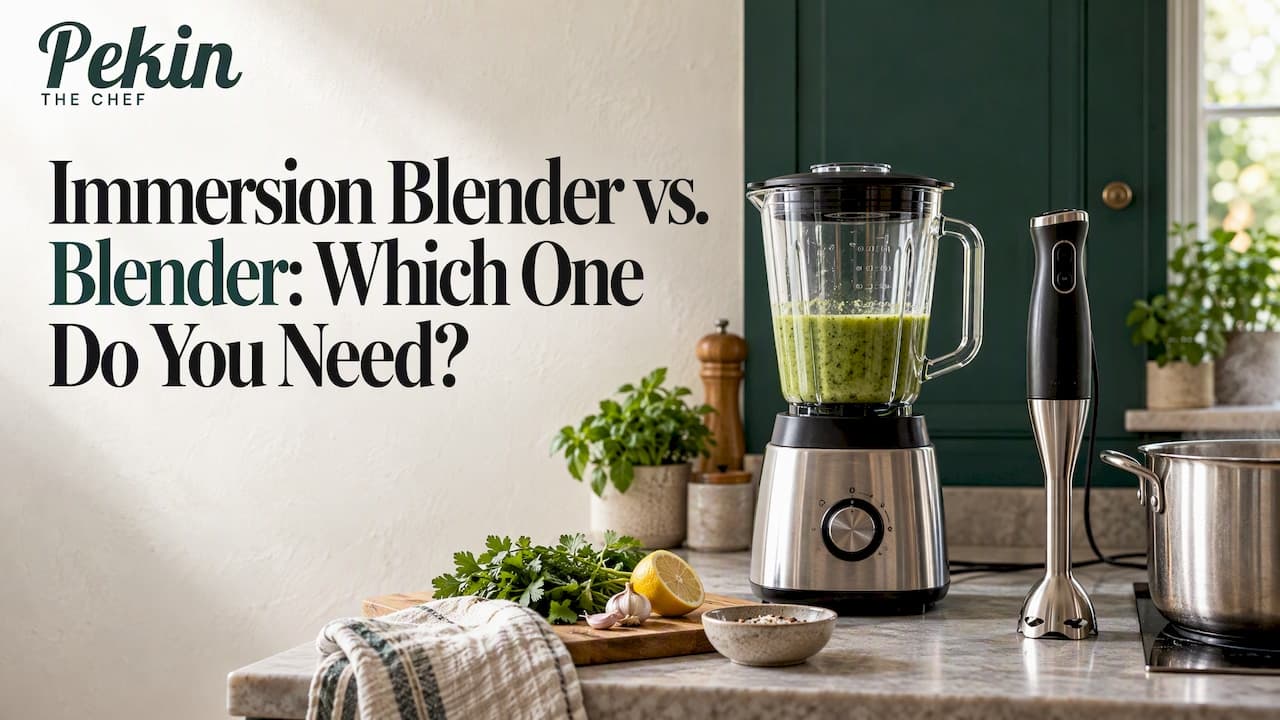
An immersion blender (also called a stick or hand blender) is the better pick if you mostly purée soups, sauces and batters right in the pot and want easy cleanup. A countertop blender is the better pick if you make frequent smoothies, crush ice or want the silkiest texture possible. Many serious home cooks end up with both, because the two tools are built for different jobs.
The real question is not which machine is "better." It is which one matches the food you actually cook on a Tuesday night. Below, we walk through how each works, where each shines, where each struggles, and how to choose without buying more appliance than your kitchen can hold.
TL;DR
- An immersion blender brings the blade to your food, so you can purée soup in the pot with no batch transfers and very little cleanup.
- A countertop blender brings the food to the blade, and its bigger motor and pitcher win for ice, frozen fruit, thick smoothies and the smoothest textures.
- Consumer Reports describes immersion blenders as designed to complement a countertop blender, not replace it.
- Immersion models are usually cheaper and smaller; Consumer Reports tested ones ranging from $30 to $200.
- If you can only own one and you cook soups, sauces and batters most, start with the immersion blender. If you live on smoothies and frozen drinks, start with the countertop blender.
Table of Contents
- The core difference: where the blending happens
- What an immersion blender does best
- What a countertop blender does best
- Side-by-side comparison
- Can you use one in place of the other?
- How to choose: three quick questions
- Using a stick blender well
- Our perspective
- Find recipes that put your blender to work
- FAQ
- Sources
The core difference: where the blending happens
The whole debate comes down to one idea. With a countertop blender, you carry the ingredients to a jar that sits on a motorized base. With an immersion blender, you carry the motor and blade to the pot, bowl or tall cup that already holds your food.
That sounds like a small distinction, but it shapes everything else: how much you can blend at once, how hot the food can be, how much you wash afterward and how smooth the result turns out.
Consumer Reports' Ginny Lui describes an immersion blender as pairing the automatic mixing of a blender with the hand-stirring motion of a spoon. That is a helpful picture. You are the one moving the blade through the food, which gives you real control, and it also means you stay at the stove or counter while it works. A countertop blender, by contrast, does its work while you step away and wipe the counter.
What an immersion blender does best
The stick blender earns its drawer space on jobs that begin in a pot or bowl. Consumer Reports lists a broad range of tasks: emulsifying oil and water, whipping mixtures, blending soups, stews and sauces right in the stockpot, whipping eggs, mixing pancake batter and puréeing thick soups.
Hot soups and sauces
This is the stick blender's signature moment. America's Test Kitchen notes that an immersion blender blends hot soup directly in the pot, which skips the batch transfers and the cooling time otherwise needed so that pressure does not pop the lid off a countertop blender.
Think of a velvety roasted pepper bisque or a creamy poblano soup. Cooking a pot of something like 2 Feet Brewing's roasted red pepper and smoked Gouda bisque or Acova's creamy poblano soup is exactly the type of recipe where you want to purée without ladling scalding liquid into a jar. Keep the head submerged and the pot at a manageable temperature, and the whole job takes a minute or two.

Easy cleanup and small kitchens
Wirecutter says immersion blenders suit hot soups and sauces, small storage spaces and cooks who dislike cleaning small appliances. The blending head can go in the dishwasher, and the base needs only a damp-cloth wipe. Consumer Reports adds a safety habit worth adopting: unplug it, detach the motorized top, and wash only the blade assembly. While you blend, keep the blade submerged to avoid splatters.
Compare that to a full-size pitcher with a gasket, a lid and a blade assembly that needs careful washing, and you can see why stick blenders are a favorite among people who cook often but hate dishes.
Batters, eggs and emulsions
Because the blade works inside a bowl or a narrow cup, a stick blender is handy for mayonnaise-style emulsions, whipped eggs and pancake batter. Use a container just wide enough for the head, and you get fast results with a single vessel to wash.
What a countertop blender does best
A standard blender is a different animal. It has a larger motor, a bigger pitcher and blades set low in a sealed jar, so the food is pulled down into a vortex and pulverized.
Smoothies, ice and frozen fruit
Engadget says countertop blenders are usually preferable for frequent smoothies, multiple servings, ice and frozen fruit, since their larger pitchers and stronger motors handle those jobs more effectively. Good Housekeeping makes the flip-side point: immersion blenders have smaller motors and blades and can handle only small jobs before overheating.

If your mornings revolve around a frozen-banana-and-spinach smoothie, or you make margaritas for a crowd, a countertop blender is simply the right tool. The same goes for frozen desserts. A recipe such as Aba Austin's lemon meringue frozen Greek yogurt or a restaurant-style ice cream invites the kind of power and tall jar that a stick blender lacks.
The silkiest textures
Wirecutter's guidance is texture-driven: a full-size, high-powered blender is the choice when perfectly smooth results matter, and an immersion blender is enough when convenience and good-but-not-maximally-silky results will do. It also points to countertop models for cooks who regularly blend nuts and ice, or who make dressings, gazpacho and margaritas.
America's Test Kitchen saw this in a smoothie test. Its favorite immersion blenders left tiny bits of kale intact, unlike its favorite midpriced and high-end countertop blenders. If you are blending leafy greens, seeds or fibrous vegetables into a drink, that difference will show up in the glass.
Dry and tough ingredients
A countertop blender can also handle tougher loads, such as nuts, but it is not the answer to everything. For dry jobs like spices or whole beans, a purpose-built tool such as coffee grinders gives you a consistent grind that a pitcher blender does not aim for.
Side-by-side comparison
| Factor | Immersion blender | Countertop blender |
|---|---|---|
| Best for | Soups, sauces, batters, small-batch purées | Smoothies, ice, frozen fruit, dips, drinks |
| Hot liquids | Blends in the pot, no transfer | Needs cooling or small batches; lid pressure is a risk |
| Texture | Good, sometimes with small bits left | Smoothest, especially with high-powered models |
| Ice and frozen fruit | Limited by a smaller motor | Built for it |
| Batch size | Whatever your pot holds | Limited by the pitcher |
| Cleanup | Rinse or wash the blade assembly | Jar, lid, gasket and blades |
| Storage | Fits in a drawer | Takes counter or cabinet space |
| Price | Consumer Reports tested models from $30 to $200 | Premium models cost more |
The price row deserves a note. Consumer Reports says immersion blenders are space-saving and less expensive than premium countertop blenders, but less powerful and slower than premium or personal blenders. Its tested immersion models ranged from $30 to $200, so a higher price does not always mean you need a bigger machine, just a better-built one.
Can you use one in place of the other?
Can you use a regular blender as an immersion blender?
Not really, in the sense of the tool. A jar blender cannot go into a pot. What you can do is work in batches: let the soup cool a bit, fill the jar no more than about halfway, vent the lid and purée in portions. America's Test Kitchen's point about cooling soup so pressure does not pop the lid is the reason this takes longer and creates more dishes. If you do this often, a stick blender pays for itself in patience.
Can you use an immersion blender for smoothies?
Yes. Wirecutter says an immersion blender can handle smoothie-making, though a full-size high-powered blender is preferable when you want a thick, spoonable smoothie or the silkiest possible texture. For best results, use soft or thawed fruit, a tall narrow cup and a little extra liquid, and skip big chunks of ice.
Do you need a blender if you already own an immersion blender?
Only if your cooking calls for it. Consumer Reports says immersion blenders are designed to complement, not replace, a countertop blender. If you rarely make smoothies, frozen drinks or ultra-smooth sauces, a good stick blender may carry your whole kitchen.
How to choose: three quick questions
- What do you blend most? If the answer is soup, sauce, batter or whipped eggs, buy the immersion blender. If it is smoothies, ice or frozen fruit, buy the countertop blender.
- How much do you value texture? If you want restaurant-silky purées and drinks, the countertop blender gets you closer. If "smooth enough" is fine, the stick blender works.
- How much space and patience do you have? A small kitchen or a dislike of dishes tips the scale toward the stick.
A few other buying notes:
- Look for variable speed. It helps you start slowly and avoid splatter.
- Check the blade guard and shaft material. If you cook in nonstick pots, a guard around the blade helps protect the surface.
- Match shaft length to your pot. A short shaft in a deep stockpot is frustrating.
- Consider cordless only if you will use it often. Corded models tend to keep going without a recharge.
If you are weighing other counter-space decisions, our comparison of Instant Pot and slow cooker uses the same logic: match the tool to the dishes you really make.
Using a stick blender well
A few habits make the difference between a silky soup and a kitchen redecorated with tomato.
- Submerge before you start. Keep the blade fully under the surface, as Consumer Reports advises, to avoid splatters.
- Tilt the pot slightly and move the blender in slow circles and up-and-down motions so everything passes the blade.
- Use a deep, narrow container for small batches, such as batters and dressings.
- Unplug it before washing. Detach the motorized top and wash only the blade assembly.
- Take hot pots off the burner while you blend, particularly if your pot has a nonstick surface.
For cold foam and other frothy coffee-shop touches, see how to make cold foam at home without a frother for ratios that work with what you already own.
Our perspective
We built Pek in the Chef around one belief: a good restaurant dish should be within reach of a home cook, and the right tool is part of that. Most of the dishes our community cooks begin the same way, in a pot or a bowl, and the first question is rarely "which machine is the most powerful?" It is "what will make this easier tonight?"
That is why we lean on community feedback. When home cooks tell us a bisque went smooth in a few minutes with a stick blender, or that a frozen dessert needed a jar blender to come together, that detail saves the next cook an evening of guesswork. Our recipes are inspired by real restaurant dishes and vetted by home cooks who rate them and leave notes, and tools come up in those notes all the time.
Our advice is practical. If you cook soups, sauces and batters, an immersion blender is a friendly place to start. If smoothies, frozen drinks and desserts are your thing, a countertop blender earns its place. Having both is not indulgence for a cook who loves to explore cuisines; it is simply having the right tool for each recipe.
Rhys
Find recipes that put your blender to work
Once you know which blender fits your kitchen, the fun part is cooking with it. Pek in the Chef collects restaurant-inspired recipes for home cooks, with ratings and feedback from other cooks, and you can search by restaurant, dish, cuisine, meal type or prep time. Soups, sauces, drinks and frozen desserts are all in the mix, so you can look for dishes that suit the blender you own.

Start on the Pek in the Chef home page to search the collection, or browse a single restaurant's page, such as 57 Ninety Restaurant recipes, to see how a menu translates to a home kitchen. Some recipes include links to kitchen tools and ingredients, and we earn a commission if you buy through them.
FAQ
Is an immersion blender the same as a stick blender or hand blender?
Yes. Immersion blender, stick blender and hand blender all name the same handheld tool: a motorized wand with a blade at the end that you place directly into the food. The names vary by brand and region, but the tool and the way you use it are the same.
Which is better for soup, an immersion blender or a regular blender?
For most soups, the immersion blender is better. America's Test Kitchen points out that it blends hot soup in the pot, avoiding batch transfers and the cooling step that protects a countertop blender's lid. If you want the absolute silkiest result, a high-powered countertop blender can edge it out, but you pay for that in time and dishes.
Is an immersion blender easier to clean?
Usually, yes. It blends in the pot or bowl you already have, and the blade assembly is the only part that needs washing, according to Consumer Reports. Wirecutter adds that the blending head can go in the dishwasher and the base needs only a damp-cloth wipe.
What is the best budget choice if I can only buy one?
If you cook soups, sauces and batters, a stick blender is the budget-friendly pick, since Consumer Reports found it generally costs less than premium countertop blenders, with tested models ranging from $30 to $200. If your priority is smoothies, ice and frozen fruit, spend on a countertop blender instead, because a stick blender's smaller motor limits those jobs.
Sources
- How to Use an Immersion Blender, Consumer Reports
- How to Choose a Blender, Consumer Reports
- The Best Immersion Blenders of 2025, America's Test Kitchen
- 4 Best Immersion Blenders, Good Housekeeping
- Do You Need a Food Processor, a Blender, or Both? Wirecutter
- The best immersion blender, Engadget