
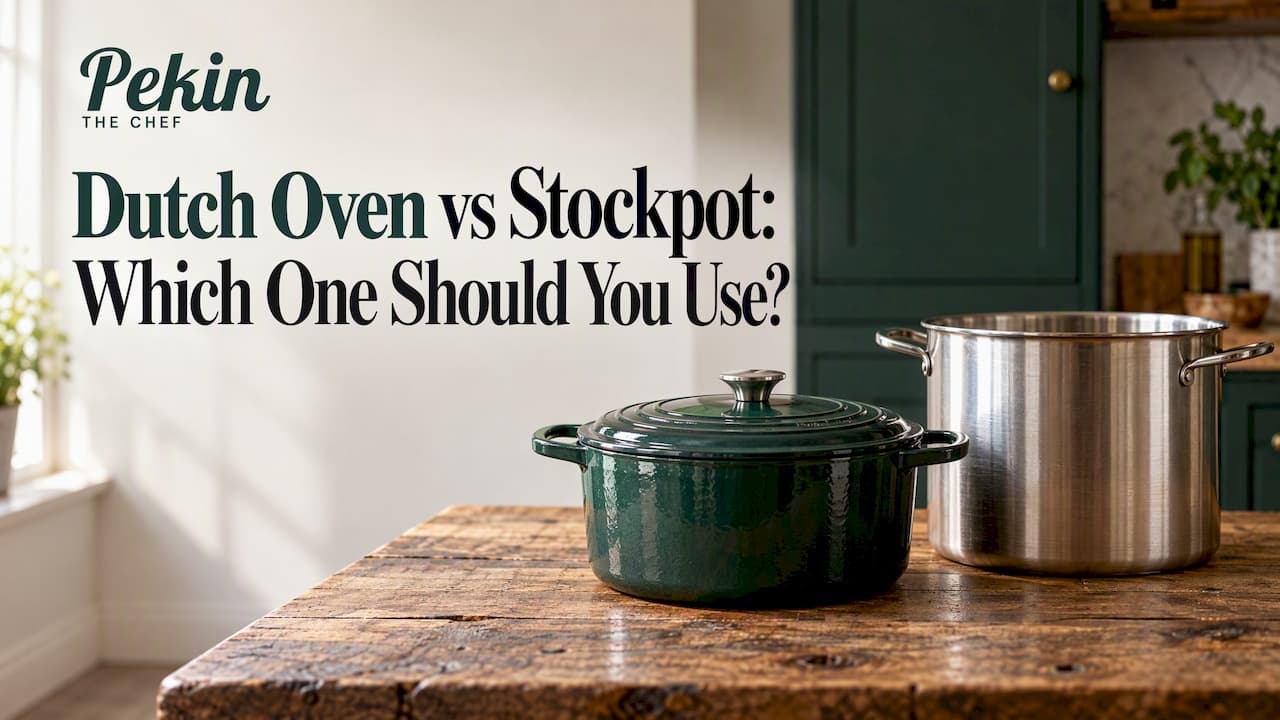
A Dutch oven is the pot for slow, gentle, oven-to-stovetop cooking: braises, stews, no-knead bread, deep frying. A stockpot is the pot for volume and speed: boiling pasta, simmering stock, big batches of soup. They overlap more than most cooks admit, but each has a job it does better, and knowing which is which can change how a pot of chili tastes. This guide walks through the real differences, the dishes that favor each pot, and what to do when you own only one. For a second take on the buying side, see this Dutch oven vs stockpot comparison.
TL;DR
- Dutch oven: heavy, thick-walled, wide and relatively short, usually with a tight lid. Best for browning, braising, stews, bread and frying, and it moves from stove to oven.
- Stockpot: tall, narrow, lighter, built for large volumes of liquid. Best for stock, pasta, boiled corn, big soups and canning-style batch work.
- Substitution: a stockpot can often stand in for a Dutch oven on the stovetop, but it browns less evenly and may scorch long, slow dishes. A Dutch oven can do most stockpot jobs at a smaller scale.
- Oven use: only if the whole pot, including lid and handles, is rated for it. Check the manufacturer's markings before you slide anything in.
- If you can own one: choose the Dutch oven for varied cooking, the stockpot if you routinely cook for a crowd.
Table of Contents
- What actually separates the two pots
- Which dishes belong in which pot
- Can you use a stockpot instead of a Dutch oven?
- Is a stockpot the same as a soup pot?
- Can a stockpot go in the oven?
- Weight, handling and care
- Choosing between them: a simple decision path
- Our perspective
- Cook the dish, then decide on the pot
- FAQ
- Sources
What actually separates the two pots
Picture them side by side. The Dutch oven is squat and broad, with thick walls and a heavy lid, often in enameled cast iron with two short loop handles. The stockpot stands taller than it is wide, often in stainless steel or aluminum, with thinner walls and a lighter build. Those two silhouettes explain nearly everything that follows.
Shape governs evaporation and access. A wide pot gives a large surface for browning meat and for liquid to reduce into something glossy and concentrated. A tall, narrow pot exposes less surface, so liquid stays put during a long simmer, which is exactly what you want when you are coaxing flavor from bones over several hours.

Material governs how heat behaves. Consumer Reports notes that enameled cast iron heats slowly and evenly and holds heat well, but is heavy. Thinner stockpot metal responds faster: it warms quickly and cools quickly, which is a virtue when you are bringing a large volume of water to a boil and a drawback when you are trying to hold a steady, gentle braise.
Side-by-side at a glance
| Feature | Dutch oven | Stockpot |
|---|---|---|
| Typical shape | Wide, shorter, round or oval | Tall, narrow, round |
| Typical material | Enameled or bare cast iron | Stainless steel or aluminum |
| Walls | Thick, heavy | Thinner, lighter |
| Heat behavior | Slow to heat, steady and even, holds heat | Heats and cools faster |
| Typical capacity use | Everyday family meals | Large batches |
| Oven use | Designed for it, when lid and knob are rated | Only if every part is rated; tall sides can be awkward |
| Weight when full | Substantial | Manageable |
| Best at | Browning, braising, baking, frying | Boiling, stock, big soups |
Which dishes belong in which pot
Consumer Reports frames the choice around cooking style: stockpots suit soup and boiling pasta, while Dutch ovens suit stews and sauces cooked low and slow. That is a reliable rule of thumb, and the details are worth knowing.
Reach for the Dutch oven when you want depth
Anything that begins with browning and ends with a long, quiet simmer belongs here. The heavy base sears meat without the temperature plunging when you add it, and the same source describes the heavy bottom and high sides as useful for browning, braising, boiling and baking bread. In practice:
- Braised short ribs, pot roast, coq au vin: brown on the stove, add liquid, cover, then finish in the oven so heat surrounds the pot instead of pushing up from one burner.
- Beans, chili and stews: the thick walls resist hot spots, so the bottom is less likely to catch.
- Crusty bread: a preheated, lidded pot traps steam and gives a loaf its blistered crust.
- Deep frying: Wirecutter points out that the heavy weight of an enameled Dutch oven helps regulate oil temperature compared with thinner pots. If you have ever tried our double fry fries, you know how much steady oil temperature matters.
- One-pot baking: a skillet-style bake such as a restaurant cast iron corn bread shows what cast iron does for a crust, and the same logic carries over to a Dutch oven.
Reach for the stockpot when you want volume
The stockpot earns its place when the pot has to hold a lot of liquid and heat it fast.
- Pasta and boiled vegetables: plenty of water, quick return to a boil, easy draining.
- Stock and broth: a tall pot keeps bones and aromatics submerged with less evaporation over a long, gentle simmer.
- Big batch soup: double a recipe for the freezer without crowding.
- Seafood boils, corn on the cob, tamales on a steaming rack: all want height and capacity more than browning power.
Dishes that work in either
Soup is where the line blurs. A silky purée like a restaurant-style tomato soup or a loaded tortilla soup cooks well in both. Choose the Dutch oven if you want to sweat the onions and build a fond first, and the stockpot if you are multiplying the recipe for a crowd.
For a dish that leans on caramelization, such as baked French onion soup, the Dutch oven is the natural fit: wide base for the onions to brown, then straight into the oven under the cheese if the pot and lid are oven-rated.

Can you use a stockpot instead of a Dutch oven?
On the stovetop, usually yes, with a few adjustments. The thinner walls and narrower base mean heat is less forgiving, so:
- Brown in batches. A narrow floor holds less meat, and crowding steams it instead of searing it.
- Lower the flame earlier. Thin metal reacts quickly, so drop to a gentle simmer sooner than you would in cast iron.
- Stir more often. Thick sauces and bean dishes are more likely to stick on a thinner base.
- Expect more evaporation or less, depending on lid fit. Check liquid levels a little earlier than the recipe says.
The oven is the harder swap. A recipe that says to cover and transfer to a 300°F oven assumes a pot built for it. A stockpot can go in only if its material, handles and lid are all rated for oven heat, and its tall sides may not fit comfortably on your rack. If it is not clearly rated, finish the dish on the stove on the lowest setting.
The reverse swap is easier. A Dutch oven can boil pasta, simmer soup and make stock in smaller quantities. It will heat more slowly, and its capacity runs out sooner.
Is a stockpot the same as a soup pot?
For most home kitchens, yes. "Soup pot" is the casual name for a stockpot, or for a mid-size sauce pot with a lid. What matters is capacity, height and a lid that fits, not the label. If you mostly cook soup for four to six people, a pot in the middle of the stockpot range does the job without the storage headache of a very large one.
Can a stockpot go in the oven?
Sometimes. Three parts decide it: the pot body, the lid and the handles or knobs.
- Body: stainless steel and many aluminum-based builds tolerate oven heat, but nonstick coatings and some bonded layers have lower limits.
- Lid: glass lids and plastic or phenolic knobs often have lower ratings than the pot itself.
- Handles: riveted metal handles are usually fine; bolted-on plastic or silicone ones are not.
Look for the manufacturer's stated maximum temperature on the box, the underside of the pot or the maker's website. If you cannot find one, treat it as stovetop only. Do not guess with a pot you love.
Weight, handling and care
Consumer Reports lists the downsides of enameled cast iron plainly: it is heavy, the small handles can be cumbersome and get hot, and the enamel can chip. None of this is a reason to skip the pot. It is a reason to use it well:
- Keep oven mitts within reach, and remember the lid knob and handles get just as hot as the pot.
- Use wooden or silicone utensils to protect the enamel.
- Let the pot cool before washing, and lift rather than drag it across the stove.
- Store it where you do not have to hoist it over your head.
A stockpot is lighter, but a full 12-quart pot is still a hazard when you carry it to the sink. Drain with a lid and a helper, or ladle out some liquid first. Wide, stable handles help.
Choosing between them: a simple decision path
Ask yourself what you cook on a typical week.
- Mostly braises, stews, one-pot dinners, bread: Dutch oven, usually in the 5 to 7 quart range for a family.
- Mostly pasta, soup in bulk, stock, seafood boils: stockpot, sized to your largest regular batch.
- A bit of everything: start with the Dutch oven. It covers more techniques, and you can add a stockpot when you start hosting or batch cooking.
- Small kitchen and one pot only: the Dutch oven is more versatile, provided you can lift it comfortably.
If you are weighing other counter and cabinet space decisions, our comparison of a rice cooker and an Instant Pot uses the same approach: match the tool to what you actually cook.
Our perspective
We build this site around restaurant dishes, and when we read through the recipes cooks send us and rate, a pattern shows up. The dishes that taste most like the restaurant version are rarely about a fancy gadget. They are about heat control. A restaurant line cook has heavy-bottomed pots that sear properly, simmer steadily and do not scorch, and a good Dutch oven brings that quality into a home kitchen. That is why we reach for it first when a recipe starts with browning and ends with a long simmer.
But we also know that a big stockpot is how a household gets through chili night for twelve, or a weekend of stock for the freezer. We do not see them as rivals. We see them as two tools with different strengths, and our recipes are written so you can tell which one the dish wants. When a recipe in our collection depends on the pot, the community feedback often says so, which is exactly the kind of practical note we want you to have before you turn on the stove.
Our suggestion: pick the pot that fits the dishes you are most excited to cook, read what other home cooks say about the recipe, and let the results guide your next purchase.
— Rhys
Cook the dish, then decide on the pot
The best way to learn what each pot does is to cook something that demands it. Pek in the Chef collects recipes inspired by real restaurant dishes, searchable by restaurant, dish, cuisine, meal type and prep time, with feedback from other home cooks on each one. Start with a braise, a soup or a bread and see how the pot behaves.

Browse the full collection on Pek in the Chef, or explore one restaurant's menu, such as 57 Ninety Restaurant recipes, to find a dish that suits the pot you already own. Some recipes include links to kitchen tools and ingredients, which may earn us a commission at no extra cost to you.
FAQ
Can I use a stockpot instead of a Dutch oven?
On the stovetop, yes, for most soups, stews and sauces. Brown in smaller batches, lower the heat sooner and stir more often, because thinner metal scorches more easily. For recipes that go into the oven, only use a stockpot if the pot, lid and handles are all rated for oven heat.
What are the disadvantages of a Dutch oven?
Mainly weight and handling. Consumer Reports notes that enameled cast iron is heavy, with small handles that can get hot and enamel that can chip. It also heats more slowly than thin metal, so it is not the fastest choice for boiling a large pot of water.
What shouldn't I cook in a Dutch oven?
There is little you cannot cook in one, but it is not ideal for huge batches of pasta water or for quick boiling jobs, where a stockpot is faster and lighter. Use wooden or silicone tools to protect enamel, and check your maker's guidance on acidic dishes and bare cast iron seasoning.
Is a Dutch oven just a pot?
In a sense, yes: it is a lidded pot. What sets it apart is the thick, heavy construction that holds and spreads heat evenly, plus the ability, in most designs, to move from stovetop to oven. That makes it better for browning, braising and baking than a thin-walled pot.
Is a stockpot the same as a soup pot?
Usually. Most home cooks use the terms interchangeably for a tall, lidded pot used for soup, stock and pasta. Choose by capacity and by how comfortably you can lift it when full.
Sources
- Best Cookware Buying Guide, Consumer Reports
- The Best Deep Fryer, Wirecutter
- Dutch oven vs stockpot comparison, Kitchenware Compare