
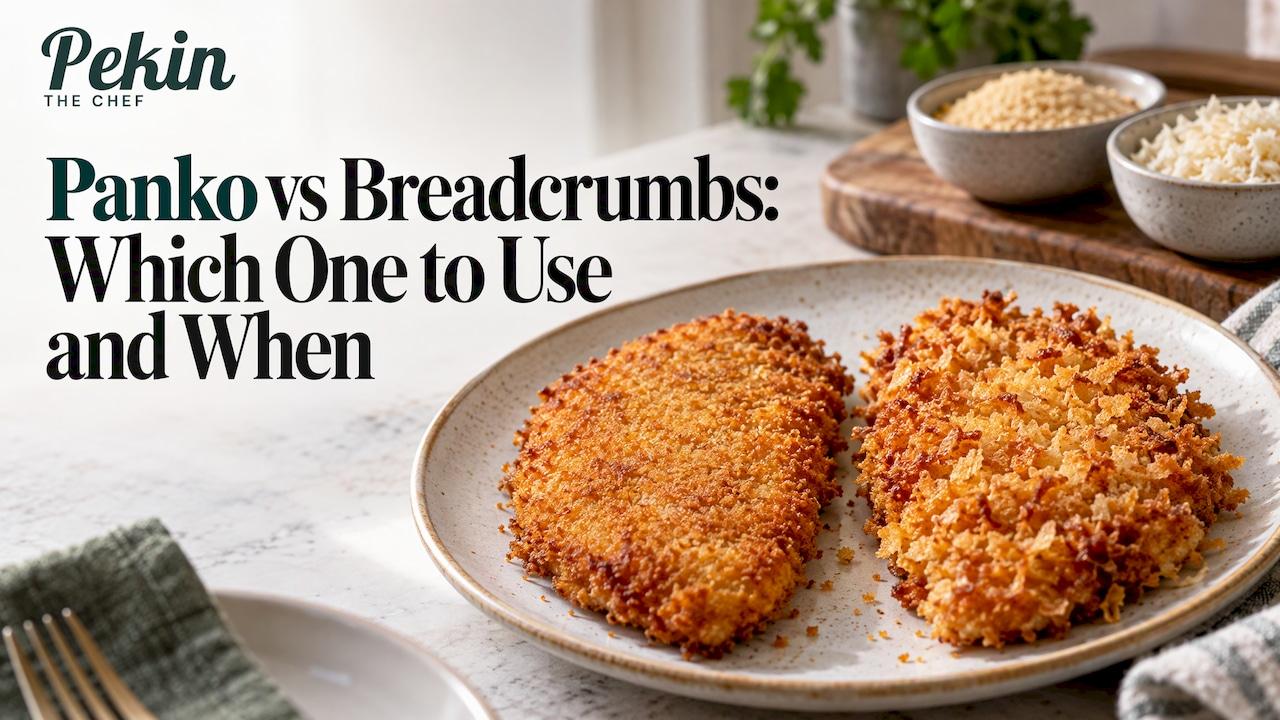
Panko is the better choice when you want a coating that shatters: light, airy flakes that stay crisp on fried cutlets, shrimp and oven-baked fish. Regular breadcrumbs are the better choice when the crumb has to disappear into something, binding a meatball, topping a casserole or filling out a stuffing. Both are dried bread, but the bread, the grind and the way each behaves in heat are different, and that difference decides whether your chicken cutlet comes out restaurant-crisp or quietly sandy. Many of the restaurant dishes our home cooks recreate rely on the panko side of that choice, so it pays to get it right.
TL;DR
- Panko is made from crustless white bread and ground into large, jagged flakes; regular breadcrumbs are finer and denser, so they brown faster and crunch less.
- Use panko for frying, pan-searing and oven-crisping, where the crunch is the point. Use fine breadcrumbs for binding, thickening and soft toppings.
- Panko is not lower in carbs: an ounce of each carries about 21 g of carbohydrates and roughly 100 calories.
- You can swap one for the other in most recipes, but expect a crunchier result with panko and a denser, finer crust with regular crumbs.
- No panko? Coarsely crushed toasted bread, crackers or cornflakes get you close.
Table of Contents
- What actually separates the two
- Fresh panko and dried panko
- When panko is the right call
- When regular breadcrumbs win
- Swapping one for the other
- What to use when you have neither
- Are panko breadcrumbs vegan?
- Is panko healthier?
- How to get the crunch right, step by step
- Storing panko and breadcrumbs
- Our take on panko, breadcrumbs and restaurant results
- Find your next crispy recipe
- FAQ
- Sources
What actually separates the two
The short version: panko starts as a different loaf. According to Kikkoman's glossary, panko is made from shokupan, the soft, standard Japanese white bread, which is then crushed into big crumbs. Shokupan has a tender, even crumb and a thin crust, and panko makers work with the crumb of the loaf, which is why the flakes are pale and have no brown specks of crust.
Regular breadcrumbs, the kind sold in a canister in most American supermarkets, can come from nearly any bread: sandwich loaf, Italian loaf, the ends of a baguette. The bread is baked, dried, ground fine and often seasoned. Because the loaf includes crust and a tighter crumb, the result is a sandy, dense powder that packs together.
You can see and feel the difference before you cook anything:
| Panko | Regular breadcrumbs | |
|---|---|---|
| Bread used | Crustless white bread (shokupan-style) | Any bread, often with crust |
| Shape | Large, airy, jagged flakes | Fine, sandy crumbs |
| Color | Pale, uniform | Tan to golden, sometimes flecked |
| Feel in the hand | Light, slightly shaggy | Dense, packs when squeezed |
| Seasoning | Usually plain | Often plain or Italian-style, with herbs |
| Typical job | Crunchy coating | Binder, filler, soft topping |
Why the shape matters in the pan
Crunch comes from surface area and air. Large flakes leave tiny gaps between them, so hot oil or hot oven air can reach into the coating and dry it out quickly, leaving a rigid, crackly shell. Fine crumbs pack tightly against the food, form a more continuous layer and hold on to more oil and moisture, which gives a thinner, more even, browner crust that is closer to a crisp breading than a crunch.

That is also why fine crumbs can taste more "bready" and panko tastes more neutral: you notice the texture before the flavor.
Fresh panko and dried panko
The panko aisle has one more wrinkle. Kikkoman explains that dry panko contains less than 14% moisture, while fresh panko contains more. The tub on a typical US grocery shelf is dried panko. Fresh panko is softer, sometimes sold refrigerated or frozen, and gives a fluffier, more delicate fried exterior, while dried panko gives a firmer texture and a longer shelf life.

For most home cooking, dried panko is what you want, and everything in this guide assumes it. If you ever find the fresh kind, know that it soaks up more oil when deep-fried, so Kikkoman notes it comes out higher in calories than dried panko.
When panko is the right call
Reach for panko whenever the coating is the star of the plate.
- Cutlets and katsu. Pork or chicken, pounded thin, dredged in flour, egg and then panko, is the classic. Our version of chicken katsu inspired by Ajimi is a good first project if you have never breaded anything this way.
- Fried seafood. Shrimp, calamari and delicate white fish need a coating that is crisp but not heavy. The butterfish from 8 Fat Fat 8 Bar & Grille is written with a panko option for this reason.
- Pan-seared crusts. A single-sided crust on a thick fillet is where panko shines, as in the panko-crusted black grouper from 1908 Provisions.
- Oven "frying." Because panko is airy and toasts evenly, it holds up in a hot oven better than fine crumbs, which can turn pasty if they never meet enough fat.
- Crunchy toppings. Mac and cheese, baked vegetables and gratins get a topping that stays crisp even under sauce.
A small trick from the pan: panko toasts fast. If you are baking, toss the flakes with a spoonful of oil in a dry skillet over medium heat until pale gold before you coat the food. You get color without waiting for a long bake to brown the crust.
When regular breadcrumbs win
Panko is not the answer to everything. Fine breadcrumbs earn their place when you need the crumb to blend in.
- Meatballs, meatloaf and crab cakes. Fine crumbs soak up liquid and fat and hold the mixture together. Panko can do this too, but it needs a few minutes to hydrate and leaves a looser, more textured interior.
- Thin, even breading. Veal or chicken Milanese, eggplant parmesan and other dishes where you want a delicate, uniform crust that clings and browns quickly.
- Stuffed vegetables and baked casseroles. A soft golden crumb tolerates steam and sauce better than a crisp one.
- Seasoned Italian-style coatings. Canned crumbs often arrive with garlic, herbs and cheese already in the mix, which suits Italian-American cooking.
In short: if you want to hear the dish, use panko. If you want to taste a savory, evenly browned crust, or you need a binder, use regular crumbs.
Swapping one for the other
This is the question behind most panko or breadcrumbs searches, and the honest answer is that either works in a pinch, with predictable changes.
Panko in place of regular breadcrumbs
In a coating, you will get a crunchier, lighter result with more visible texture. In a binder, use the same volume but let the panko sit in the wet ingredients for five to ten minutes so it hydrates, or crush it lightly in a bag first. Since panko is airier, a cup of panko holds less bread than a cup of fine crumbs, so if your meatloaf feels loose, add a spoonful or two more.
Regular breadcrumbs in place of panko
Expect a denser, browner, finer crust that absorbs more oil. To get closer to the panko effect:
- Use plain, unseasoned crumbs, or you will be adding herbs and salt the recipe did not plan for.
- Press them on lightly, rather than packing them, so some air remains in the coating.
- Fry or bake a little more gently. Fine crumbs brown sooner, so lower the heat slightly and watch the color rather than the clock.
- Use a touch less crumb by volume, because fine crumbs pack tighter into the measuring cup.
Is a single-ingredient swap ever a bad idea?
Only in recipes where the crunch is the whole promise. A katsu or a tempura-style shrimp made with fine crumbs will taste fine, but it will not have that glassy shell. Everything else forgives the swap.
What to use when you have neither
If the panko substitute question brought you here, check the pantry in this order:
- Toasted fresh bread. Take plain white sandwich bread, trim the crust if you like, dry it in a low oven until crisp, and pulse it in a food processor until coarse. This is the closest homemade stand-in, and it follows the same principle: large, dry, airy crumbs.
- Crushed crackers. Saltine-style or butter crackers, smashed in a zip-top bag with a rolling pin, give a crisp, savory coating. Skip extra salt in the recipe.
- Cornflakes. Lightly crushed, unsweetened cornflakes make a famously crunchy chicken coating. Keep the pieces chunky rather than powdery.
- Rolled oats or crushed pretzels for baked toppings, where an extra nutty or salty note is welcome.
- Crushed potato chips or rice cereal for oven-baked fish or chicken tenders.
The gluten-free cook has the same options: gluten-free bread dried and crushed the same way, or crushed gluten-free cereal, both of which work as coatings. Check the label either way.
Are panko breadcrumbs vegan?
Panko is traditionally made from flour, water, yeast, sugar and salt, so many plain versions are vegan, but ingredients differ by brand. Some include milk, whey, egg or honey, and seasoned or Italian-style crumbs more often do. Read the ingredient list on the package, and look for a vegan or dairy-free label if you want certainty. If you are coating with egg wash, a mix of plant milk and flour or a spoonful of mustard thinned with water holds the crumbs on just as well.
Is panko healthier?
Not in any meaningful way. Healthline's nutrition breakdown lists about 100 calories and 21 g of carbs in a 1-ounce serving of panko, against 98 calories and 21 g of carbs for regular breadcrumbs. The same article notes that whole grain breadcrumbs offer more fiber and iron than either white version. If you care about that, look for whole wheat panko or whole grain crumbs.
What does change is how much oil ends up on the plate. Panko's open structure means a thin layer can go a long way, and when you are oven-baking you can get a crisp crust with only a light brush or spray of oil. Kikkoman's glossary also lists fiber, potassium, iron, zinc and B vitamins among panko's nutrients, all in modest amounts per serving, so the real nutritional lever is the cooking method, not the crumb.
How to get the crunch right, step by step
The crumb is half the job. The rest is the sequence.
- Dry the food. Pat chicken, fish or vegetables thoroughly. Moisture under the coating turns it to steam and the crust slides off.
- Season the food, not just the crumbs. Salt the protein or vegetable first. Plain panko carries almost no flavor of its own.
- Set up three shallow dishes. Flour, beaten egg, crumbs. Use one hand for the dry stations and the other for the wet one so your fingers do not turn into clumpy breaded mittens.
- Press, do not pile. Press the panko on firmly with your palm so the flakes lock into the egg.
- Rest the coated pieces. Ten minutes on a rack lets the coating set, which cuts down on bald spots when the food hits the pan.
- Fry at a steady temperature. If the oil is too cool, panko soaks up grease. If it is too hot, the flakes burn before the center cooks. Work in batches so the oil does not drop.
- Drain on a rack, not paper towels. A rack keeps the bottom crisp, where a towel traps steam.
The same logic carries through recipes that go beyond chicken. Crispy chicken tenders in the style of 99 Restaurants and the crispy rock shrimp from 8 East both depend on a dry surface, a firm coating and well-managed oil. Crispy tuna patties also respond well to a panko crust; the crispy tuna patties recipe shows how a light coating turns pantry staples into dinner in about 25 minutes.
Storing panko and breadcrumbs
Dried crumbs are shelf-stable and forgiving. Kikkoman's guidance is that dried panko should go in an airtight container at room temperature or in the refrigerator, while fresh panko can be stored at room temperature before opening and frozen after opening. The same airtight habit suits regular breadcrumbs. Keep them away from steam over the stove, since moisture is what turns crisp flakes stale, and check the best-by date on the package. If the crumbs smell musty or oily, replace them. If they have merely gone soft, a few minutes in a dry skillet or a low oven brings the crunch back.
Our take on panko, breadcrumbs and restaurant results
Restaurant cooks rarely choose a crumb by accident. When a dish arrives at the table with a crust that crackles, the crumb was chosen for its shape, then the oil, the egg wash and the timing were all built around it. That is why we pay attention to it in the recipes we collect.
At Pek in the Chef, every recipe is inspired by a real restaurant dish and reviewed by home cooks who tell us what worked in an ordinary kitchen. That feedback is what turns a vague instruction like "coat in breadcrumbs" into something you can trust: which crumb, how firmly to press, how long to rest it. Our recipes can be searched by restaurant, dish, cuisine, meal type and prep time, so you can find the crispy dishes you love and see what the cooks who made them thought.
If you take one thing from this guide, let it be this: match the crumb to the job. Panko for crunch, fine crumbs for body, and a little patience between the egg and the pan.
Rhys
Find your next crispy recipe
If you want to put panko to work, browse our full collection of restaurant-inspired recipes and search by dish, restaurant or cuisine. Each recipe comes with feedback from other home cooks, so you can see how the crust turned out for people cooking in kitchens like yours.

For fried and breaded dishes especially, the recipes also point you to the tools and ingredients that make the job easier, from a wire cooling rack to the right pantry staples.
FAQ
Can I use panko instead of regular breadcrumbs?
Yes, in almost any recipe. Panko gives a crunchier, lighter coating and a looser texture when used as a binder. If a recipe needs the crumbs to absorb liquid, let the panko soak for a few minutes or crush it lightly first.
Can I use regular breadcrumbs instead of panko?
Yes, though the crust will be finer, denser and a little more golden. Use unseasoned crumbs, press them on gently, and lower the heat slightly because fine crumbs brown faster.
Do panko breadcrumbs expire?
They go stale rather than dangerous, and the package carries a best-by date. Kept in an airtight container, dried panko lasts well at room temperature or in the refrigerator. Discard crumbs that smell musty or rancid, and refresh soft ones in a dry skillet.
Is panko lower in carbs than breadcrumbs?
No. A 1-ounce serving has about the same calories and carbohydrates as regular breadcrumbs, roughly 21 g of carbs each. Whole grain crumbs add more fiber.
What can I use if I have no panko?
Dry plain white bread in a low oven and pulse it coarsely in a food processor. Crushed crackers or unsweetened cornflakes also work, as long as you keep the pieces chunky and go easy on added salt.
Sources
- Panko / Japanese Breadcrumbs | Glossary | Kikkoman
- Panko Breadcrumbs: Nutrition, Benefits, and Uses | Healthline