
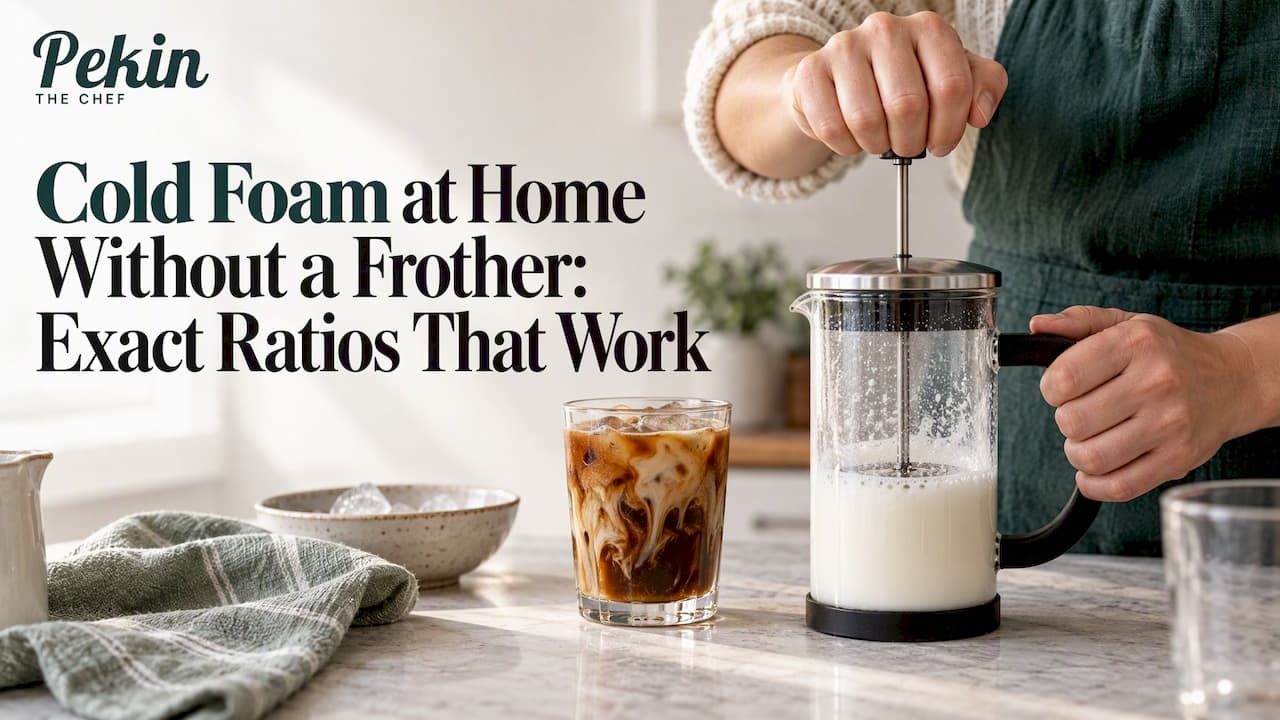
Want café-style cold foam fast? Use a quarter cup of cold skim milk or barista oat milk, add a teaspoon of simple syrup, and froth briefly with a handheld frother. The result is a light, pillowy layer that floats beautifully on iced coffee instead of sinking into it. This basic formula works with most common milks and takes well to vanilla, brown sugar, or matcha if you want to dress it up.
TL;DR:
- For richer foam, combine two tablespoons of heavy cream, a quarter cup of whole milk, and one teaspoon of vanilla syrup; froth for 15 to 25 seconds.
- A handheld frother suits one drink and needs 15 to 30 seconds, while a countertop model with a cold foam setting works better for multiple servings.
- Barista oat milk most closely matches dairy; almond and soy usually need barista blends or longer frothing, while cold foam settings help alternatives.
- Too much fat weakens foam, so choose lower fat milk or reduce the cream; collapsed foam may recover after another 5 to 10 seconds of frothing.
- Because bubbles collapse quickly, serve cold foam within minutes; refrigerate leftovers in an airtight jar and briefly froth them again before serving.
Table of Contents
- Ingredient Ratios and What Each One Does
- Which Frothing Method Should You Use?
- Three Tested Cold Foam Recipes
- Flavor Variations and Add-Ins Worth Trying
- Why Does Cold Foam Separate, and How Do You Fix It?
- Storage, Shelf Life, and Food Safety
- Why We Still Make Cold Foam by Hand
- Find More Restaurant-Inspired Recipes at Pek in the Chef
- FAQ
- Sources
Ingredient Ratios and What Each One Does
Cold foam comes together from just a few ingredients, but the ratios matter more than most people expect. These three combinations give us a reliable starting point, each suited to a different mood:
- Classic cold foam: a quarter cup of milk plus one teaspoon of simple syrup.
- Sweet cream cold foam: two tablespoons of heavy cream, a quarter cup of milk, and one teaspoon of vanilla syrup.
- Single-serve heavy foam: three tablespoons of heavy cream, two tablespoons of milk, and one tablespoon of syrup.
The reason skim milk froths so readily comes down to protein. Milk proteins act as surface-active agents, forming a cohesive film at the air and water boundary that traps bubbles and holds them there, and that stabilizing effect depends heavily on protein concentration and how much fat is competing for space in the mixture, according to a technical review of milk foaming behavior. Fat coats the air bubbles and weakens that film, which is why skim milk whips into a drier, more structured foam while cream alone resists holding air at all. Blending a small amount of cream into a mostly low-fat base, like the sweet cream ratio above, lets us keep richness without losing the lift.
When it comes to alternatives, barista-style oat milk tends to foam closest to dairy because it is formulated with added fats and proteins that mimic how skim or whole milk behaves under a frother, a point confirmed by testing across milk types. Almond and soy milks can work too, but they usually need a barista blend or extra frothing time to reach the same volume.
Which Frothing Method Should You Use?
Almost any kitchen gadget can turn milk into decent cold foam, and the one you already own is probably good enough. Independent testing of milk frothers found that most handheld and countertop models produce satisfactory texture, with cold-foam-specific settings giving an edge on plant-based milks.
- Handheld frother: submerge the whisk fully in the milk and run it for 15 to 30 seconds, lifting slightly near the end to pull in extra air. Best for a single cup, and the fastest option on this list.
- Countertop frother: switch to the cold-foam setting if your model has one, and let it run its cycle. Worth using when you are making foam for more than one drink at a time.
- Immersion blender: angle the wide whisking head just under the surface and pulse in short bursts so the motor does not warm the milk.
- French press: pump the plunger multiple times to aerate the milk, then let the foam settle for a few seconds before pouring.
- Blender: run at high speed for batches, but watch the clock. Leaving it running too long overworks the mixture and collapses the bubbles instead of building them.
- Mason jar: shake vigorously for about a minute or more as a no-equipment fallback. It takes more effort and the foam is looser, but it gets the job done.
Pro Tip: Chill your frother head or jar in the freezer for a few minutes before use. Cold tools help the milk hold its structure longer once it is aerated.
Three Tested Cold Foam Recipes
These three versions cover the range from everyday to indulgent, each built around the ratios above and ready in under a minute of active frothing.
Classic cold foam. Combine a quarter cup of cold skim milk or barista oat milk with one teaspoon of simple syrup and, if you like, an eighth of a teaspoon of vanilla extract. Froth for 15 to 25 seconds until the mixture doubles in volume and holds soft peaks. This yields enough to top an 8 to 12 ounce iced coffee.
Sweet cream cold foam. Whisk together two tablespoons of heavy cream, a quarter cup of whole milk, and either one teaspoon of vanilla simple syrup or half a teaspoon of vanilla extract. Froth for 15 to 25 seconds, or pulse the mixture in a French press if that is what you have on hand. The added cream makes this version noticeably richer without turning it heavy.
Froth for just 10 to 20 seconds, since the higher fat content thickens faster than the lower-fat versions. This one is less a floating layer and more a cloud you spoon onto a drink.
For all three, pour the finished foam gently over ice so it stays on top, or use a spoon to hold back the bulk of it and let it settle slowly. If your foam tastes flat, add syrup in small increments rather than all at once. Liquid sweeteners dissolve cleanly into cold milk, while anything granular risks leaving a grainy finish.

Flavor Variations and Add-Ins Worth Trying
Once the base ratio is set, flavoring cold foam is mostly a matter of proportion and timing.
- Vanilla: one teaspoon of vanilla simple syrup or a quarter teaspoon of vanilla extract per quarter cup of milk.
- Brown sugar or caramel syrup: dissolve brown sugar in equal parts hot water to make a quick syrup, then add it the same way as simple syrup, starting with one teaspoon per quarter cup of milk.
- Matcha: sift half a teaspoon to one teaspoon of matcha powder into the milk before frothing, then give it a quick extra blitz to break up any clumps.
- Cream cheese foam: a small amount of soft cream cheese blended into the cream and milk mixture adds tang and a denser, almost cheesecake-like texture, a variation popularized in cheese foam tea recipes.
- Non-dairy swaps: barista oat milk foams closest to dairy, while almond and soy milks usually need a barista blend or a longer frothing time to catch up.
Why Does Cold Foam Separate, and How Do You Fix It?
Most texture problems trace back to fat and temperature, both of which interfere with how milk proteins trap air.
- Too much fat weakens the protein film that holds bubbles together, so switching to a lower-fat milk or trimming back the cream in your ratio restores lift.
- Milk froths best cold, since chilled proteins hold their structure longer once aerated, an effect tied to how temperature changes protein conformation during processing, as described in research on milk foaming properties.
- Collapsed foam can often be revived with a brief 5 to 10 second re-froth, though if it has separated into liquid and fat, it is faster to remake it.
- Grainy or clumpy foam usually means a powdered add-in did not dissolve. Sift matcha or cocoa before mixing, and favor syrups over granulated sugar.
Storage, Shelf Life, and Food Safety
Cold foam is best made fresh and served within minutes, since the air bubbles that give it structure start collapsing almost immediately, a pattern confirmed by test kitchen guidance on homemade cold foam. If you need to store it, keep it in an airtight jar in the fridge for a short window and re-froth briefly before serving. Use pasteurized dairy and standard refrigeration practices, the same ones you would apply to any fresh milk product.

Why We Still Make Cold Foam by Hand
There is something satisfying about watching plain milk turn into something that looks and tastes like it came from a counter you did not stand behind. Over repeated kitchen tests and feedback from fellow home cooks, we have found that the small adjustments, a little more cream here, a shorter froth there, matter more than any single tool. That hands-on tinkering is exactly what shapes the recipes we share.
— Rhys
Find More Restaurant-Inspired Recipes at Pek in the Chef
If this cold foam has you thinking about what else your favorite coffee shop or restaurant makes that you could recreate at home, our collection at Pek in the Chef is built for exactly that curiosity. Many recipes come with feedback from other home cooks who have tested them, so you know what to expect before you start measuring.

Browse our drink and dessert recipes for more café and restaurant favorites you can make in your own kitchen.
FAQ
Can I make cold foam at home without a frother?
Yes, a French press, mason jar, or blender all work as effective substitutes. Pump a French press plunger multiple times, shake a sealed jar vigorously for about a minute or more, or blend on high in short bursts until the milk doubles in volume.
Can you turn whole milk into cold foam?
Whole milk can be frothed into cold foam, though its higher fat content makes the foam a bit less airy than skim milk produces. For a lighter, more stable foam, skim milk or a barista-style oat milk tends to perform better.
What ingredients do you use to make cold foam?
The base is simply cold milk and a liquid sweetener like simple syrup, usually in a ratio of a quarter cup of milk to one teaspoon of syrup. Richer versions add a tablespoon or two of heavy cream, and flavors like vanilla, brown sugar, or matcha can be mixed in before frothing.
Is cold foam just whipped milk?
Cold foam is milk that has been aerated without heat, which gives it a lighter, more pourable texture than whipped cream. Unlike whipped cream, it is not meant to hold stiff peaks. It is designed to float on a cold drink and slowly blend in as you sip.