
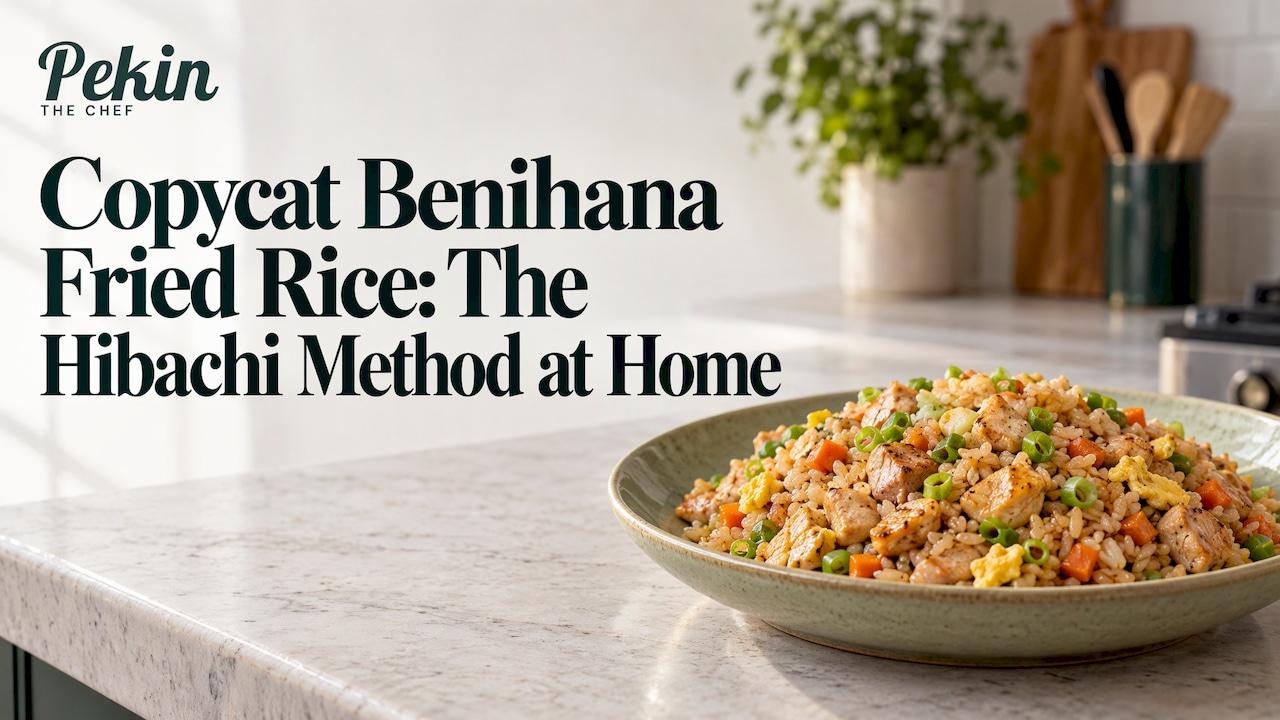
The hibachi flavor you remember comes from three things: rice with dry, separate grains, garlic butter melted into a very hot surface, and eggs scrambled right in the rice and chopped small. Get those three right and a home skillet gets remarkably close to the teppan. Below is the full recipe, the reasoning behind each step, and what to do if you have no day-old rice, no soy sauce or no flat-top grill.
TL;DR
- Use cold, dry rice. Day-old is best, and a quick bake-sheet chill works if you are cooking tonight.
- Garlic butter is the signature. Melt it in the pan first, then build the rest around it.
- Cook in small batches on high heat so the rice browns instead of steaming.
- Scramble the eggs in the pan, chop them small, then fold in rice, carrots, onion, scallion and chicken.
- Season with soy sauce at the end, a little at a time, and taste as you go.
Table of Contents
- What makes Benihana-style fried rice taste the way it does
- Start with the rice
- The copycat recipe
- Where homemade fried rice goes wrong
- Questions that come up in every home kitchen
- Turning it into a full hibachi night
- Getting more of that restaurant sizzle
- A note on pad thai at home
- Our perspective
- Find your next restaurant favorite
- FAQ
- Sources
What makes Benihana-style fried rice taste the way it does
A hibachi steakhouse is a show, but the rice is a quiet piece of craft. Benihana describes its Hibachi Chicken Rice as steamed California-grown white rice, diced chicken, eggs, carrots, onion and green onion, garlic-flavored butter and a soy-based seasoning, cooked and browned on the teppan, the flat iron griddle at the center of the table. Its chefs melt garlic butter on the griddle, scramble and chop the eggs, then toss in the rice, vegetables and chicken until browned.
That short list tells you a lot. There is no sesame-heavy sauce, no ginger, no oyster sauce. The flavor is buttery, savory and garlicky, with a toasted edge from the hot steel. The vegetables are finely diced so that every forkful carries a little of everything, and the eggs are broken into small golden flecks rather than large curds.
At home you are missing the big griddle, so the job is to recreate its three conditions: dry rice, high heat, and room to brown. Everything in the method below serves one of those.
Start with the rice
The most common reason homemade fried rice turns out gummy is warm, wet rice. Freshly steamed grains are soft and full of moisture, and when they hit the pan they smear together instead of searing.
America's Test Kitchen hosts Kevin and Jeffrey Pang explain that day-old rice has stiff, dry clumps that relax during cooking into tender-firm, distinct grains you can push around without turning them mushy. That is exactly the texture a hibachi chef is working with.

If you do not have day-old rice
The same source offers a workaround for a same-day dinner: cook the rice about 2 hours ahead, spread it on a rimmed baking sheet, let it cool completely, then chill it for 30 minutes. Use it at roughly room temperature. The thin layer lets steam escape quickly, which is the whole point.

Which rice to use
Plain medium or long-grain white rice is the right base. Its neutral flavor lets the garlic butter lead, and it fries into separate grains more readily than most whole-grain styles. If you are curious how the two compare in the bowl, this look at brown rice versus white rice is a pleasant read before you decide what to serve alongside your hibachi night.
The copycat recipe
This serves four as a side or two as a hearty main. It is our home-kitchen adaptation of the method above, so quantities are a starting point to adjust to your taste.
Ingredients
- 4 cups cold cooked white rice, grains separated with your fingers
- 4 tablespoons unsalted butter, softened
- 3 cloves garlic, finely minced
- 1 tablespoon neutral high-heat oil, such as canola or vegetable
- 2 large eggs, lightly beaten
- 1 small carrot, finely diced
- 1/4 cup finely diced yellow onion
- 3 scallions, thinly sliced, whites and greens kept separate
- 1 cup diced cooked chicken (optional; shrimp or steak work too)
- 2 to 3 tablespoons soy sauce, plus more to taste
- Black pepper, to taste
Step 1: Make the garlic butter
Mash the softened butter with the minced garlic and a teaspoon of the soy sauce. Doing this ahead means the garlic is already distributed through the fat, so it perfumes the rice instead of burning in one spot. You can make it hours in advance and keep it chilled.
Step 2: Heat the pan properly
Use the largest flat-bottomed pan you own. The America's Test Kitchen guidance calls for a well-seasoned 14-inch flat-bottomed wok or a 12-inch nonstick skillet, and the size matters: a crowded pan traps steam and your rice will boil in its own moisture. Heat it over medium-high to high until the oil shimmers.
Step 3: Cook the vegetables first
Add the oil, then the carrot and onion with the scallion whites. Stir for two to three minutes until the onion turns translucent and the carrot softens at the edges. Push everything to one side.
Step 4: Scramble and chop the eggs
Pour in the eggs on the empty side and scramble until just set. Then chop them with the edge of your spatula into small pieces, exactly as the teppan chefs do. Small flecks distribute better and feel lighter in the rice.
Step 5: Add the rice and the butter
Add the rice and press it flat against the pan for 30 seconds at a time, then toss. This gives you little toasted spots, the closest home equivalent to the browning on a griddle. Add a generous spoonful of the garlic butter and let it melt into the grains.
Step 6: Add chicken and season
Fold in the chicken, then drizzle in the soy sauce around the edges of the pan, not on top of the rice, so it sizzles and caramelizes slightly. Taste. Add more soy sauce a teaspoon at a time and finish with black pepper, the remaining garlic butter and the scallion greens.
Step 7: Serve immediately
Hibachi rice is at its best straight from the pan, when the butter is still glossy and the edges are crisp.
Where homemade fried rice goes wrong
Most failures trace back to a handful of habits. Here is how each shows up and how to fix it.
| Problem | Likely cause | Fix |
|---|---|---|
| Mushy, clumped rice | Warm, freshly cooked rice or too much moisture | Chill the rice thoroughly; spread it thin on a sheet pan to cool |
| Pale, steamed rice | Crowded pan or low heat | Cook in two batches; keep the heat high |
| Burned garlic | Garlic added to a dry, very hot pan | Mix it into softened butter and add late |
| Too salty | Soy sauce added all at once | Add a teaspoon at a time and taste |
| Greasy rice | Too much butter early | Use a small amount of oil first, butter at the end |
Questions that come up in every home kitchen
What do hibachi restaurants add to their rice?
Based on what Benihana lists for its Hibachi Chicken Rice, the core is garlic-flavored butter and a soy-based seasoning blend, plus egg, carrot, onion and green onion. That is why the dish tastes buttery rather than heavily saucy. Keep your seasonings short and let the butter do the work.
Can you use olive oil?
You can, but it is not the best fit. Hibachi cooking relies on high heat, and a neutral oil with a high smoke point such as canola or vegetable handles that more comfortably. If you love the flavor of olive oil, save it for a drizzle on a different dish, and use the butter for flavor and a neutral oil for the sear here.
What can you use instead of soy sauce?
Tamari is the closest swap and tastes nearly the same. Coconut aminos are sweeter and milder, so you will likely need a pinch of salt. Anyone avoiding soy or gluten should read the label of whatever bottle they choose.
Turning it into a full hibachi night
The rice is the anchor, and a few companions make the table feel like the restaurant.
- Protein: Sear chicken, shrimp or steak in the same pan before the rice, set it aside, and fold it back in at the end.
- Vegetables: Zucchini and mushrooms cook quickly on high heat and take on the same garlic butter.
- Something crisp: Garlic tempura from 8 Fat Fat 8 Bar & Grille adds crunch next to the soft rice.
- Seafood over rice: 1693 Red Zone Grill's honey jerk shrimp and salmon over hibachi rice shows how far a good hibachi rice base can travel.
Getting more of that restaurant sizzle
A flat-top griddle is hard to replicate on a home stove, but heat is something you can manage. Preheat longer than feels necessary, work in batches, and keep the rice moving only enough to avoid scorching. For the smoky depth that high-heat wok cooking gives, our guide to wok hei at home walks through the technique in detail.
If you want to branch into other fried rice styles, 9 Thai Cuisine's pineapple fried rice is a sweet, aromatic contrast to the buttery hibachi profile. For a different kind of savory, the Mexican restaurant rice guide applies the same restaurant-at-home thinking to a tomato-toasted grain.
A note on pad thai at home
Many readers who search for restaurant-style fried rice are also chasing pad thai, and the two share a lesson: high heat, small batches and everything prepped before the pan gets hot. Pad thai has its own flavor base, a sweet, sour and salty sauce built around tamarind, fish sauce and sugar, tossed with rice noodles rather than rice. For a restaurant-inspired noodle dish from our collection to practice the same skills, try 8 Asian Food Dumpling and Noodles' stir fried noodles.
Our perspective
We built Pek in the Chef around a simple frustration: a recipe that promises restaurant flavor and then delivers something merely pleasant. Fried rice is the perfect example. The difference between a forgettable pan of rice and the one people talk about for weeks is rarely an exotic ingredient. It is technique, and technique is something home cooks learn best from each other.
That is why every recipe in our collection is inspired by a real restaurant dish and comes with feedback from other home cooks. When someone tells you the garlic butter should be added late, or that their rice finally browned once they cooked in two batches, you trust the recipe more, and you cook it better.
You can search by restaurant, dish, cuisine, meal type or prep time, so the path from craving to dinner is short. And because we keep adding trending and unique dishes from both our curators and our community, there is always another plate to try after this one.
Rhys
Find your next restaurant favorite
If this recipe has you wondering what else a home kitchen can pull off, Pek in the Chef gathers community-vetted recipes inspired by real restaurant dishes, searchable by restaurant, dish, cuisine and prep time, with meals and drinks side by side. Browse the full collection at Pek in the Chef and see what other home cooks are making.

If the garlic butter sparked an interest in Asian-inspired comfort food, you might start with 2nd Language Ramen's karaage rice bowl or 53's Hainanese chicken and rice.
FAQ
Can I make Benihana-style fried rice with freshly cooked rice?
Yes, if you cool it properly. Cook the rice about two hours ahead, spread it on a rimmed baking sheet, let it cool completely and chill it for 30 minutes, then fry it at roughly room temperature. This reproduces the dry, separate grains of day-old rice.
Why is my fried rice not browning?
Usually the pan is too crowded or not hot enough. Work in smaller batches in a large flat-bottomed pan, preheat until the oil shimmers, and press the rice against the surface for short intervals before tossing.
Do I need a flat-top grill?
No. A 12-inch nonstick skillet or a large flat-bottomed wok will do the job. The goal is a wide surface and high heat, and a few smaller batches make up for the lack of a teppan.
Can I make it without chicken?
Absolutely. The signature flavor comes from the garlic butter, eggs and soy-based seasoning, so you can leave the chicken out, or swap in shrimp, steak or extra vegetables.
How much soy sauce should I use?
Start with two tablespoons for four cups of rice, add it around the edges of the pan, and taste before adding more. Different brands vary in saltiness, so a little at a time is the safest approach.
Sources
- Benihana Fried Rice: Hibachi Chicken Rice Favorite
- Simple Fried Rice by Kevin and Jeffrey Pang, America's Test Kitchen, via CBS News
- Brown Rice vs White Rice: Which to Choose