
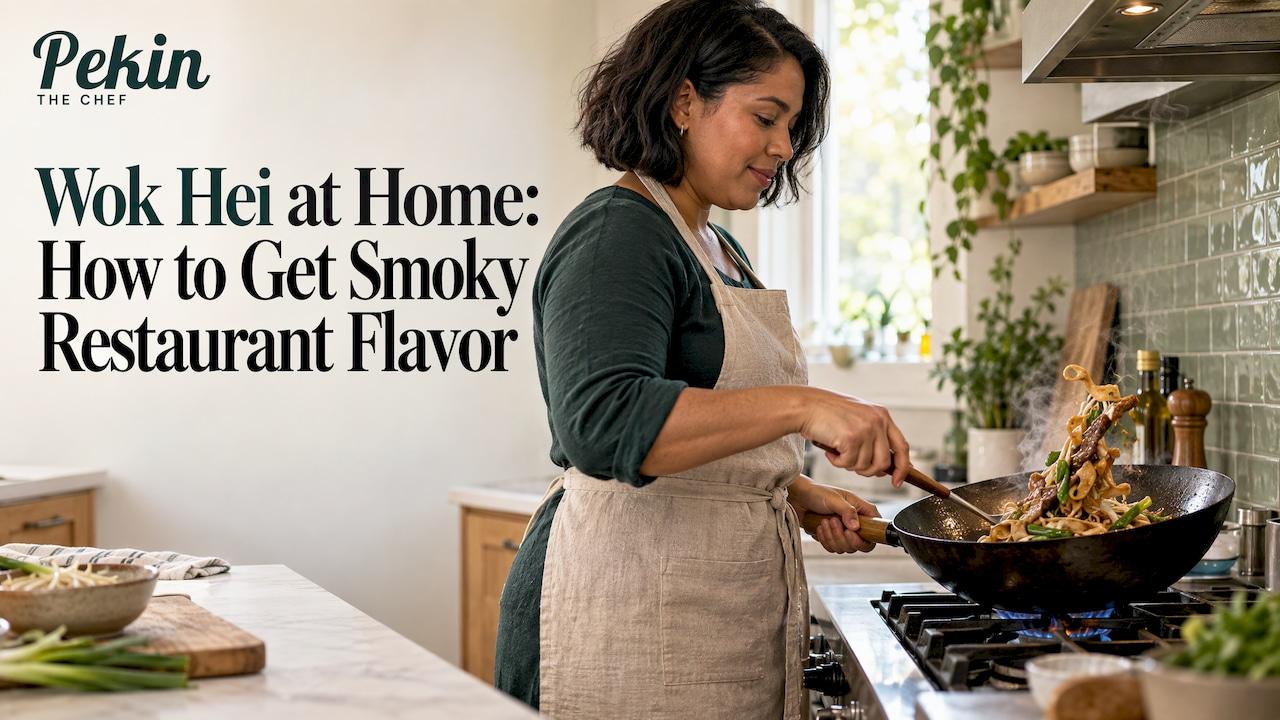
Wok hei, the smoky, savory edge that makes restaurant stir-fries and fried rice taste alive, comes from three things you can control at home: a wok that touches your heat source, ingredients that are dry and cut small, and the discipline to cook in small batches over the hottest heat your stove can give. You will not match a restaurant's flame exactly, but you can come surprisingly close, and this guide shows you how, step by step.
TL;DR
- Wok hei (literally "breath of the wok") is the seared, slightly smoky flavor of food tossed over very intense heat.
- Heat the empty wok until it just begins to smoke, then add cold oil, and keep the food moving.
- Cook in small batches and dry your ingredients, so the temperature never collapses and nothing steams.
- On electric or induction, use a flat-bottomed wok and manage timing and heat; a magnet should stick to the wok if you cook on induction.
- Ventilate well, especially if you stir-fry often, and treat any torch with real caution.
Table of Contents
- What wok hei actually is
- Why it is hard at home, and why that is fine
- Start with the right wok
- Prepare everything before the heat goes on
- The technique, step by step
- Getting wok hei on electric and induction stoves
- Fried rice: where wok hei shows off
- About the kitchen torch
- Fumes, ventilation and cooking smart
- Common mistakes and quick fixes
- Our perspective on cooking like a restaurant
- Practice with recipes inspired by real restaurants
- FAQ
- Sources
What wok hei actually is
The phrase is Cantonese and translates roughly as "breath of the wok." It describes the taste you get from a plate of beef chow fun or egg fried rice at a great Chinese restaurant: a gentle smokiness, a toasty sear on the edges, and a savory depth that a pan of soft, simmered vegetables never reaches.
Cooks and scientists still debate exactly where it comes from. New Scientist reports that part of it may be Maillard reactions, the browning chemistry that gives seared meat and toasted bread their flavor, while some chefs credit the combustion of oil, especially when food is tossed into the air so tiny droplets of oil ignite. Smoke itself may play a part too. For a home cook the practical lesson is the same whichever explanation wins: you need very high heat, a little oil, fast movement and food that browns instead of steaming.
Why it is hard at home, and why that is fine
A restaurant wok sits over a burner built to blast heat up the sides of the pan. The Michelin Guide describes wok hei as needing intense heat that is difficult to reach without a commercial cooking range. That is honest, and it explains why the first home attempt so often ends in gray, watery vegetables.
But difficult is not impossible. The goal at home is not to copy a 100,000-BTU burner. It is to protect the heat you do have. Every habit below has the same job: keep the wok hot, keep the food dry, and keep the wok from being overwhelmed.
Start with the right wok
The wok decides how much of your stove's heat actually reaches the food.
Match the shape to your stove
On a gas range, a traditional round-bottomed wok can nest over the flame, and a flat-bottomed one works as well. On a smooth-top electric range, the choice matters more. Consumer Reports says a flat-bottomed wok is the best bet there, because a round bottom wobbles and touches the heat source over very little area.
Induction needs one extra check. The same Consumer Reports guide advises testing with a magnet: if it sticks to the wok, the wok should work on an induction cooktop. The Global Cooksafe Coalition adds that a flat-bottomed wok helps ensure contact between the induction surface and the pan, and notes that commercial induction woks used abroad have a concave cooking area designed to deliver intense, responsive heat that wraps around food much as gas flames do.

Carbon steel is the usual choice
Most cooks aiming for wok hei choose carbon steel, which heats fast and responds quickly when you lift it off the burner. It also builds a dark, naturally slick surface with use, often called seasoning. Treat that patina as a flavor asset, not a stain. If you are comparing cookware more broadly, our guide to ceramic versus nonstick pans explains how different surfaces behave on the stove, which helps you decide what belongs in your everyday rotation and what stays reserved for high-heat work.
Size and weight
A 12- to 14-inch wok suits most home burners. Bigger is not better if your burner cannot heat the whole base. A pan that is evenly hot across its bottom will out-sear a larger pan that is only hot in the middle.
Prepare everything before the heat goes on
Stir-frying is fast, usually just a few minutes at the stove, so the real work happens beforehand. Think of it as the mise en place that makes the rest possible.
- Cut everything to a similar, small size. Thin slices and small dice cook in the seconds you have before the wok cools.
- Dry your ingredients. Wet vegetables or meat flood the wok with steam and drop the temperature. Pat everything with a towel, and let washed greens air-dry or spin them.
- Measure your sauce in advance. Soy sauce, rice wine, a pinch of sugar and a cornstarch slurry should be mixed in a small bowl within arm's reach.
- Line up aromatics. Garlic, ginger and scallions burn quickly, so have them ready to go in at the right moment.
- Use cold rice for fried rice. Day-old rice, spread out and chilled, has dried a little and separates into grains that toast instead of clumping.
Protein deserves special care. Restaurants often give chicken and beef a silky texture before they hit the wok, and the same trick works at home. Our article on how to tenderize chicken like a restaurant walks through the method, which pairs beautifully with a hot wok because tender meat only needs a short sear.
The technique, step by step

Step 1: Preheat the empty wok until it just begins to smoke
Set the burner to its highest setting and let the dry wok heat. The Michelin Guide instructs cooks to heat the wok until it just begins to smoke before adding cold oil. Give it time: on a home stove this can take several minutes, and rushing is the most common mistake. What goes wrong: a wok that is merely warm turns every ingredient into a simmer.
Step 2: Add cold oil, not hot oil
Swirl in a thin film of oil with a high smoke point. The same Michelin source warns against heating the oil together with the wok or the food, since they will stick and begin to char. Adding cold oil to a hot wok lets it spread across the surface and cling to the metal, creating a naturally nonstick layer for the next few seconds.
Step 3: Cook in batches
Crowding is the enemy. Michelin advises not overcrowding the wok so that temperatures do not plummet and the food does not steam. If you are cooking for a family, sear the meat first and remove it, cook the vegetables next, then bring everything back together at the end. Two or three quick batches beat one soggy pile every time.
Step 4: Toss without stopping
Keep the food moving with a spatula or by flicking the wok. Constant tossing exposes each piece to the hot metal and, as the research above suggests, may help tiny oil droplets and juices vaporize and brown. If you are not comfortable tossing the pan, a fast scoop-and-fold with a spatula does most of the job.
Step 5: Add aromatics and sauce last
Garlic and ginger need only seconds. Pour sauce around the edge of the wok instead of over the center, so it hits the hot metal and sizzles. Work quickly, then plate right away. Wok hei fades as food sits, which is why restaurant stir-fries are served the moment they are done.
Step 6: Return the batches and finish
Add the cooked components back, give everything a few final tosses to marry the flavors, and serve. A stir-fry like our stir-fried noodles recipe, inspired by a real restaurant dish, is a great place to practice all six steps in one go.
Getting wok hei on electric and induction stoves
Many home cooks assume that a flat electric or induction cooktop rules out wok hei. It does not, but it changes your method.
The Global Cooksafe Coalition quotes a School of Wok chef who says they have achieved wok hei on induction for 20 years by managing timing and maneuvering the heat. The idea is that a flat cooktop heats only where the wok touches it, so you adapt instead of fighting it.
Here is how that looks in practice:
- Use a flat-bottomed wok so the whole base touches the surface.
- Preheat longer than you would on gas, with the burner on its highest setting, until the empty wok just begins to smoke.
- Use smaller batches. A smaller amount of food loses less heat, so the sear survives.
- Lift and slide. If the wok cools, rest it back on the surface for a few seconds between tosses, since the burner supplies heat only through the base.
- Skip the long toss. Because the sides of a flat wok stay cooler, keep food moving in the center, where the heat is.
On a standard gas range, the same rules apply, but the flame also licks up the sides of a round-bottomed wok, so you get a bit more latitude and a bit more of that smoky character.
Fried rice: where wok hei shows off
Fried rice is the dish most home cooks want to nail, and it rewards every habit above.
- Use cold, day-old rice, broken up with your fingers.
- Preheat the wok until it just begins to smoke, then add cold oil.
- Scramble the egg first, in a few seconds, and push it aside or remove it.
- Add the rice in a thin layer and let it sit for a moment before tossing, so some grains toast against the metal.
- Toss constantly, add scallions and a small amount of soy sauce around the edge of the wok, and plate immediately.
Two portions at a time is plenty. If you try to cook enough rice for the whole family in one go, the wok cools and the rice steams.
About the kitchen torch
Some cooks add a culinary torch to give a finished stir-fry a final scorch. If you try it, treat it as a tool that demands full attention, not a gimmick. The manufacturer's user care and instruction manual says never to leave an ignited torch unattended, to point it away from your face, body and flammable objects, and to keep a fire extinguisher nearby. It also says to fill a torch in a well-ventilated area or outdoors.
For best results, keep the torch moving, use it only briefly on a finished dish, and keep towels, paper and loose sleeves clear of the work area.
Fumes, ventilation and cooking smart
Wok cooking creates real smoke, and that is worth respecting. A 1995 laboratory study of heated cooking oils found that heated oils in a wok produced volatile compounds, including acrolein, and that both cooking temperature and the type and refining level of the oil influenced the amount. It also noted that lowering the temperature or adding an antioxidant reduced emissions. That points to a simple takeaway: choose a suitable, refined high-smoke-point oil, use only as much as you need, and do not keep the wok smoking longer than the recipe requires.
A later study from Singapore in PLOS ONE found that women who cooked with a wok more than seven times a week had higher urinary markers of acrolein and crotonaldehyde exposure than those cooking less than once a week. Its authors recommend properly ventilated kitchens. A related PubMed record of the same study states the same preventive advice: improve ventilation to remove cooking oil fumes efficiently when people cook often with woks.
So, practically:
- Run your range hood on high, and make sure it vents outdoors if yours does.
- Open a window or door to draw fresh air through the kitchen.
- Cook the hottest part of the dish quickly, then move on to sauce and plating.
- If you stir-fry many times a week, treat ventilation as part of your kit, as much as the wok itself.
A clean, well-run kitchen supports all of this, and a short read on keeping a kitchen healthy covers the wider picture of kitchen hygiene and air. If you have asthma, a heart or lung condition, or you are pregnant, ask your doctor how much high-heat cooking fume exposure is sensible for you.
Common mistakes and quick fixes
| Problem | Likely cause | Fix |
|---|---|---|
| Gray, watery vegetables | Wok overcrowded or ingredients wet | Cook in smaller batches and dry everything first |
| Food sticks and chars | Oil heated together with the wok or food | Preheat the empty wok, then add cold oil |
| No smoky flavor | Wok never reached smoking point | Preheat longer on the highest setting |
| Rice clumps | Rice too fresh and wet | Use cold, day-old rice, broken apart |
| Wok wobbles on cooktop | Round bottom on a smooth top | Switch to a flat-bottomed wok |
| Wok will not heat on induction | Cookware is not magnetic | Test with a magnet before cooking |
Our perspective on cooking like a restaurant
Restaurant flavor is rarely magic. It is a set of small, repeatable habits, and wok hei is the clearest example: heat, dryness, speed, and the nerve to cook less food at a time.
At Pek in the Chef, every recipe is inspired by a real restaurant dish, and each comes with feedback from other home cooks. That feedback matters most with technique-driven cooking. When someone reports that their stir-fry finally sizzled on an electric range, or that smaller batches rescued their fried rice, the next cook benefits from a result that has been tried in an ordinary kitchen, not only a professional one.
We would encourage you to pick one dish, practice the same method three times, and read what other cooks noticed. Searching by restaurant, dish or cuisine makes it easy to keep exploring once the wok feels like yours.
Rhys
Practice with recipes inspired by real restaurants
Technique sticks when you cook with it. On Pek in the Chef you can browse recipes inspired by popular restaurant dishes, search by restaurant, dish or cuisine, and see ratings and comments from other home cooks before you shop or light the stove. Start on the Pek in the Chef home page and look for noodle, rice and stir-fry dishes to practice the six steps above.

If you want a good first project, try the stir-fried noodles recipe and apply the preheat, cold oil and small-batch rules.
FAQ
How do I get wok hei flavor at home?
Preheat an empty wok on your highest heat until it just begins to smoke, then add cold oil and cook small batches of dry, small-cut ingredients. Keep the food moving and serve right away. The method matters more than any single gadget.
Can I get wok hei on an electric or induction stove?
Yes, with adjustments. Use a flat-bottomed wok so it contacts the surface, and check that a magnet sticks if you cook on induction. Preheat longer, cook in smaller batches, and manage your timing and heat, as the chef quoted by the Global Cooksafe Coalition describes.
Do I need a huge burner for wok hei?
Intense heat is the key ingredient, and the Michelin Guide notes that it is hard to reach without a commercial range. At home, you protect the heat you have by preheating fully, drying ingredients and never overcrowding the wok.
Is wok hei healthy?
Occasional stir-frying is a normal part of home cooking, and the research mainly concerns fumes from heated oil. Studies suggest that lower cooking temperatures, suitable oils and good ventilation reduce exposure, particularly for people who wok-cook many times a week. If you have a lung or heart condition, ask your doctor about cooking fumes.
Sources
- The science of how wok hei makes stir-fried food taste so good, New Scientist
- What is wok hei? Michelin Guide
- Can you achieve wok hei on induction? Global Cooksafe Coalition
- Buying a wok, Consumer Reports
- Culinary torch user care and instruction manual
- Mutagens from heated Chinese and U.S. cooking oils, PubMed
- Elevated levels of mercapturic acids of acrolein and crotonaldehyde, PLOS ONE
- Elevated levels of mercapturic acids of acrolein, PubMed record
- Why pest control in kitchens matters for your health