
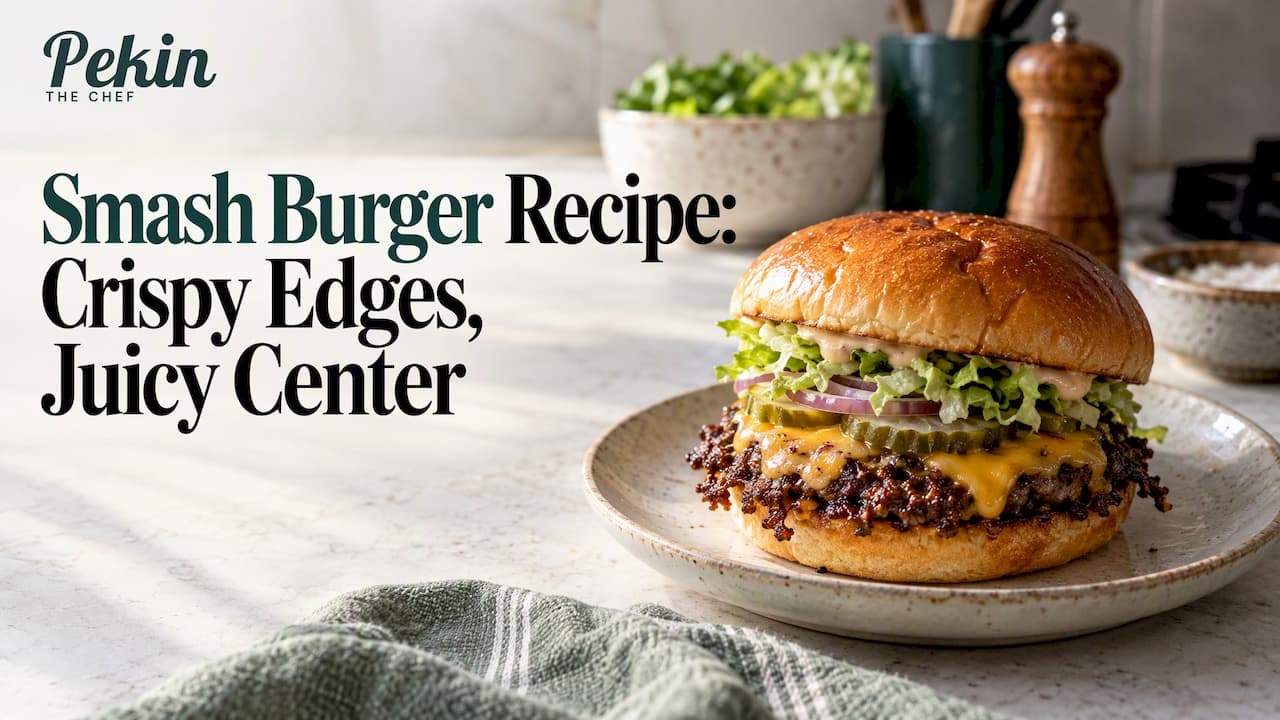
A great smash burger is a lesson in restraint: cold beef, a ferociously hot skillet, one decisive press, and a few minutes of attention. The reward is a patty with a lacy, deeply browned crust, a tender center, and a blanket of melted American cheese, all on a soft, buttery bun. This is the recipe and the reasoning behind it, so you can make it at home on cast iron, carbon steel or a griddle, and get the same result every time.
TL;DR
- Use ground beef at roughly 80/20 lean to fat, keep it cold, and roll it into loose balls of about 4 ounces each.
- Get your pan very hot, smash each ball once within the first 30 seconds, then leave the patty alone.
- Season after the smash, scrape (don't lift) the patty when you flip it, and add American cheese right away.
- Cook to a food-safe temperature: the USDA lists 160°F for ground meats, so check with a thermometer.
- Have buns toasted and sauce ready before the beef touches the pan, because the cooking takes only minutes.
Table of Contents
- What makes a smash burger different
- The ingredients, and why each one matters
- Equipment you actually need
- The recipe: four smash burgers
- Doneness and food safety
- Smash burgers on cast iron, a griddle, or the grill
- Smash burger troubleshooting
- Our perspective: why we trust the technique over the toppings
- Where to go from here: variations worth trying
- Find more restaurant-inspired recipes
- Smash burger FAQ
- Sources
What makes a smash burger different
A classic backyard burger is thick, gently formed and cooked for its juices. A smash burger turns that idea inside out. The patty is pressed thin against a hot surface, so almost every square inch meets the metal and browns. That browning, the Maillard reaction, is where the flavor lives: savory, nutty, faintly sweet, with edges that crackle.
The New York Times Cooking recipe describes the ideal as edges so thin and lacy that they shatter when you bite in. Everything below serves that one goal. The ingredient list is short on purpose, which means each ingredient and each step has to be right.
The ingredients, and why each one matters
The beef
Buy ground beef with about 20% fat. The NYT recipe calls for an 80/20 lean-to-fat ratio, and ground chuck is a natural fit. As the fat renders in the pan, it effectively fries the edges of the patty in its own juices. Leaner blends dry out and never develop that crisp fringe.
Some cooks go a little richer: George Motz's published recipes for a fried onion burger use a 75/25 chuck, which shows how comfortable the pros are with generous fat. Ask the butcher counter for a fresh grind if your store offers one, and keep the meat in the refrigerator until the moment you shape it.
The cheese
American cheese is the traditional answer, and for good reason. It melts into a smooth, creamy blanket that contrasts with the salty crunch of the beef. Cheddar works, but it doesn't melt as uniformly, and you lose that nostalgic drive-thru feel. Unwrap your slices before you start.
The bun
Choose a soft potato roll or a plain, squishy hamburger bun. A sturdy bakery bun will fight the thin patty. Butter the cut sides and toast them in the pan first, so they pick up a golden surface that keeps the sauce from soaking through.
The toppings
Keep them simple: thinly sliced onion, pickles, shredded lettuce, and a sauce. If you want a sauce worth making ahead, our guide to smash burger sauce explains why a 30-minute rest makes it taste like it came from a restaurant kitchen.
Equipment you actually need
You don't need a commercial flattop. Smash burgers can be cooked indoors on a carbon steel pan, a cast-iron skillet, or a griddle, and any flat surface with even heat will do. What matters is mass and heat retention.
- A heavy 12-inch cast-iron skillet or griddle. Cast iron holds heat when cold beef lands on it, which is exactly what you want. A thin nonstick pan will drop in temperature and steam the meat.
- A stiff metal spatula or bench scraper. You need a sharp, rigid edge to scrape under the crust. A flexible plastic turner will leave the best part behind.
- A smasher or a second heavy spatula. A burger press or the flat of a sturdy spatula both work.
- Parchment squares. A small square of parchment between the meat and your smasher keeps the beef from sticking, as the NYT recipe suggests.
- An instant-read thermometer. More on this below.
- A good vent fan or open window. A hot pan makes smoke. That's part of the process.
The recipe: four smash burgers
Makes: 4 single burgers (or 2 double-patty burgers per person if you're feeling generous)
Active time: about 25 minutes
For the burgers
- 1 pound ground beef, about 80/20, cold
- 4 soft hamburger or potato buns
- 2 tablespoons softened butter, for the buns
- 4 slices American cheese
- Kosher salt and freshly ground black pepper
- A neutral oil with a high smoke point, only if your pan needs it
For serving
- Thinly sliced white onion
- Dill pickle chips
- Shredded lettuce
- Burger sauce of your choice
Step by step
- Prep everything first. Slice the onion, shred the lettuce, unwrap the cheese, and spread sauce on the top buns. Thin patties cook in about 60 to 90 seconds per side, so there's no time to prep mid-cook.
- Portion the beef cold. Divide the meat into four equal balls of about 4 ounces. Roll them loosely, just enough to hold together, and return them to the refrigerator. Overworking the meat makes a dense, springy patty.
- Toast the buns. Butter the cut sides and toast them in your skillet over medium heat until golden. Set them aside, bottoms up on plates.
- Heat the pan hard. Turn the heat to medium-high and let the skillet preheat for several minutes, until a drop of water skitters and vanishes. A well-heated, heavy-bottomed skillet promotes even browning and crust development.
- Smash once. Place one or two beef balls in the pan, well spaced. Lay a square of parchment on top and press down firmly and evenly with your spatula until the patty is thin, about 4 to 5 inches across. Do it in the first 30 seconds or so, while the fat is still cold. Smash later and you squeeze the juice out instead of building crust.
- Season now. Sprinkle salt and pepper over the top of the smashed patty. Early salt can cure the surface of the meat, leading to a sausage-like texture, so wait until after the smash.
- Leave it alone. Don't press again. Squeezing a cooking patty pushes out rendered fat and juices and leaves you with a dry burger. Watch the edges: when they turn deep brown and lacy and the top looks mostly cooked, it's time.
- Scrape and flip. Slide the edge of your metal spatula or bench scraper under the patty at a low angle and scrape aggressively, so the dark crust comes with the meat. Practitioners recommend scraping at about 45 degrees so none of that caramelized flavor stays behind on the pan.
- Cheese immediately. Lay a slice of American cheese on the flipped patty. Cook for another 30 to 45 seconds, just until melted and the beef is cooked through.
- Stack and serve. Move the patty to a toasted bottom bun, add onions and pickles, then the top bun with sauce. Eat right away. A smash burger waits for no one.
Doubles, if you're ambitious
The classic restaurant move is two thin patties with cheese between them. The Serious Eats team explored this idea when they split a single four-ounce patty into two, which gives you twice the crust for the same amount of beef. Smash two 2-ounce balls side by side, flip both, and stack them with a slice of cheese between.
Doneness and food safety
Smash burgers cook so quickly that it's tempting to rely on color or timing. A thermometer is more reliable. The USDA's safe minimum internal temperature chart lists 160°F for ground meats. The reason is that grinding mixes surface bacteria throughout the meat, so a patty isn't safe just because the outside looks seared.
A thin patty is tricky to probe, so slide the thermometer in from the side, into the center of the patty, as soon as it comes off the pan. If you want a deeper walkthrough, this guide to a meat thermometer routine for home cooks covers where to place the probe and how to build the habit. Whoever you're serving, whether children, older relatives, or anyone pregnant or immunocompromised, hold to the USDA number. If you have questions about a specific health situation, ask your doctor.

Smash burgers on cast iron, a griddle, or the grill
Cast iron is the most forgiving option for home cooks. It's cheap, it holds heat, and it builds a dark crust on the patty. Preheat it longer than you think you need to, and cook in batches so you don't crowd the surface and drop the temperature.
A griddle or a Baking Steel placed over a grill or oven gives you more surface and more even heat. If you cook on the grill, you need a solid flat surface, because the beef will fall through grates. Whichever you choose, the same rules apply: cold beef, hot surface, one smash, seasoning afterward.
Smash burger troubleshooting
| Problem | Likely cause | Fix |
|---|---|---|
| No crust, gray patty | Pan not hot enough, or too many patties at once | Preheat longer and cook in smaller batches |
| Patty sticks to the spatula | Meat is warm or the tool is dry | Use a parchment square and keep the beef cold |
| Dry, tough burger | Lean beef, or repeated pressing | Use 80/20 and smash only once |
| Crust stays on the pan | Flipping rather than scraping | Use a stiff metal scraper at a low angle |
| Dense, springy texture | Overworked or salted meat | Roll the balls lightly and season after smashing |
| Smoky kitchen | Normal, but fat is burning | Turn on the fan, wipe the pan between batches |
Our perspective: why we trust the technique over the toppings
At Pek in the Chef, we collect recipes inspired by the dishes people love at restaurants, and we put them in front of home cooks who rate them and tell us what worked in their own kitchens. Burgers are one of the most-asked-about dishes in that world, and the pattern is always the same: cooks assume the secret is an exotic blend or a complicated sauce, when the real difference is heat, timing and patience.
What we like about the smash burger is that it respects the cook. There's no mystery ingredient. If you understand why the beef is cold, why the pan is hot and why you smash only once, you can improvise the rest. Swap the sauce, add grilled onions, pile on pickles. The crust stays the star.
We'd also say this: a smash burger is a dish where small errors show up immediately, which is why community feedback matters so much. When several home cooks say the same thing, such as that their first batch stuck until they added parchment, that's the sort of detail we want to pass along. Start with the plain version, learn how your own stove behaves, and then get creative.
— Rhys
Where to go from here: variations worth trying
Once you've nailed the basic method, a few ideas to explore:
- Add heat and character. Our green-chile smashbun burger is inspired by a restaurant dish and shows how a smashed patty can carry bolder flavors.
- Turn it into a sandwich night. The same smash-and-toast logic applies to a smashbun grilled cheese if you want something for the vegetarians at the table.
- Go thicker, with a restaurant burger. If a pressed thin patty isn't what you're craving, browse a premium chuck burger or a house burger from a historic inn for a heftier style.
- Go plant-based. A Beyond Burger recipe gives you a different path if you're cooking for a mixed crowd.
Find more restaurant-inspired recipes
If you like cooking dishes that taste like a night out, Pek in the Chef is built for you. Search by restaurant, dish or cuisine, filter by meal type and prep time, and read what other home cooks say before you turn on the stove. Start at the Pek in the Chef home page and see what's trending. Some recipes also point to kitchen tools and ingredients through affiliate links, which is how we keep the site running.
Smash burger FAQ
How do you smash a smash burger?
Place a cold ball of beef on a very hot surface, cover it with a square of parchment, and press down hard with a flat, sturdy spatula until it's thin. Do it within the first 30 seconds, then don't press again. Later pressing just squeezes out the juices.

How many ounces should a smash burger be?
For a single burger, about 4 ounces of beef gives you a thin patty with a good crust and enough substance for a satisfying bite. For doubles, use two 2-ounce balls per burger. Both approaches work, so pick the one that suits your appetite.
Can you make smash burgers on a grill?
Yes, but not directly on the grates. Put a cast-iron skillet, griddle or steel plate on the grill, preheat it thoroughly, and cook the burgers on that solid surface. You get the grill's heat, plus the contact browning that makes a smash burger what it is.
What's the best beef for a smash burger?
Ground beef with around 20% fat, such as 80/20 ground chuck, is the standard. The fat renders and crisps the edges, while leaner beef tends to turn dry. Keep it cold until it hits the pan.
How do I know when a smash burger is done?
Look for deeply browned, lacy edges, then confirm with an instant-read thermometer. The USDA lists 160°F as the safe minimum for ground meats, so use that number rather than judging by color.
Sources
- Smash Burgers Recipe, NYT Cooking
- Classic Smashed Burgers Recipe, Serious Eats
- The Ultimate Smash Cheeseburger Recipe, Serious Eats
- Smash Burger Recipe, Baking Steel
- George Motz smashburger recipes, Good Morning America
- What Is a Smash Burger, Martha Stewart
- Safe Minimum Internal Temperature Chart, USDA FSIS
- Ground Beef and Food Safety, USDA FSIS