
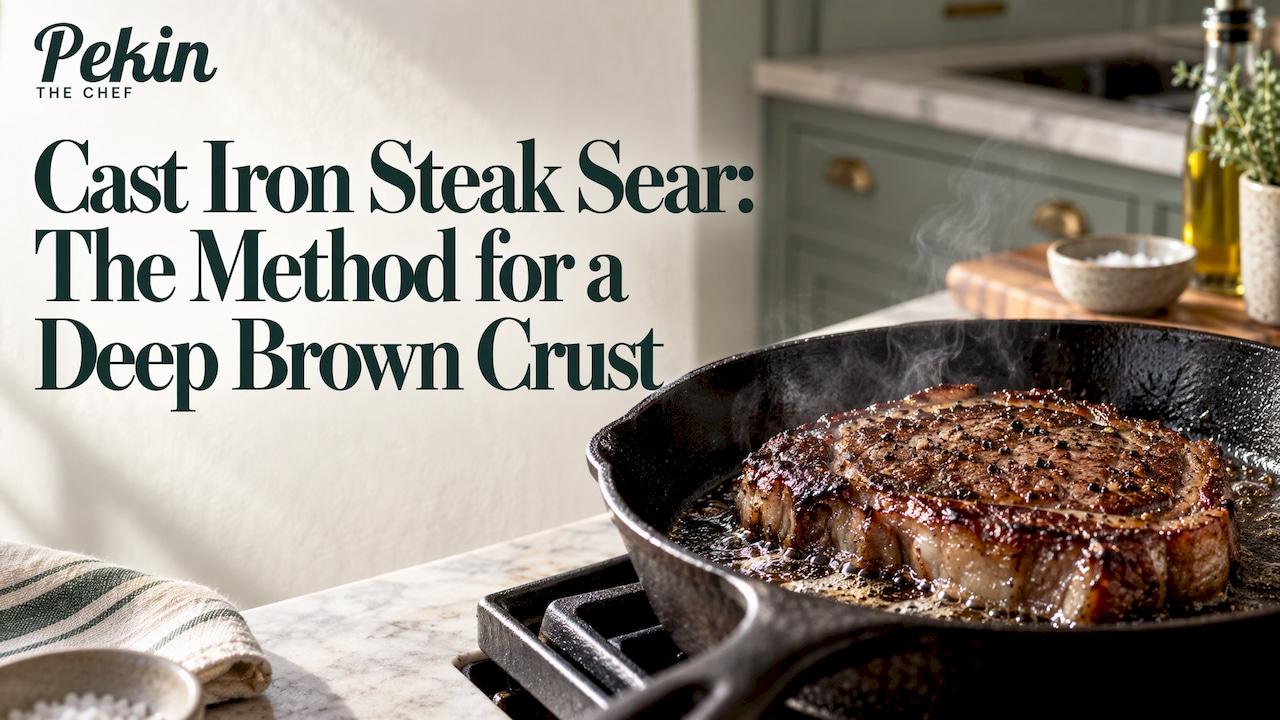
To sear a steak in cast iron, start with a dry, well-salted steak about 1 to 1.5 inches thick. Heat a heavy skillet until it is nearly smoking, add a high-smoke-point oil, and lay the steak down. Leave it alone until it releases easily, flip once, and pull it a few degrees before your target temperature. Then rest it. Everything below explains why each step matters, so you can repeat the result on any night, with any cut.
A good sear is the signature of the steakhouse plate: a mahogany crust, a juicy center, and that savory, nutty aroma that fills the kitchen. It is also one of the most reliable things a home cook can master, because a cast iron skillet does the hardest part for you. It holds heat.
TL;DR
- Pick a steak 1 to 1.5 inches thick, pat it completely dry, and salt it generously, ideally well ahead of cooking.
- Preheat the cast iron skillet until it is very hot and just beginning to smoke, then add an oil with a high smoke point such as avocado oil.
- Sear undisturbed for roughly 3 to 5 minutes a side for a typical steak, flip once, and finish with butter, garlic and herbs if you like.
- Use a thermometer: pull the steak about 5°F below your target, and rest it so the juices settle.
- Thicker cuts do best with a gentle oven start or a reverse sear, then a fast finishing sear in the skillet.
Table of Contents
- Why cast iron is the pan for searing steak
- Choosing the right steak
- Prep: dry, salted and not ice cold
- Heat and fat: the two decisions that make the crust
- The sear, step by step
- Timing by thickness and doneness
- Doneness temperatures and food safety
- Resting, and why you pull early
- When the steak is thick: the reverse sear
- Common mistakes and quick fixes
- Making the most of your skillet
- Our perspective
- Cook a restaurant steak at home
- FAQ
- Sources
Why cast iron is the pan for searing steak
Searing is about browning, and browning needs two things: a very hot surface and a dry steak. Cast iron is dense, so once it is hot it stays hot. When a cold steak lands on thin steel, the pan temperature sags and the meat starts to steam in its own juices. A heavy cast iron skillet absorbs that shock and keeps the surface scorching, which is what builds the crust.
The browning itself is the Maillard reaction, in which proteins and sugars meet intense heat and produce hundreds of flavor compounds, as this explanation of the chemistry describes. It is the reason a seared steak tastes deeper and more savory than a boiled or steamed one. Moisture is its enemy, which is why so much of good searing happens before the steak ever touches the pan.
There is a second, quieter advantage. A well-seasoned skillet develops a naturally slick surface over years of use, and it carries the fond, those browned bits left behind, straight into a pan sauce. Few pieces of kitchen equipment reward patience as generously.
Choosing the right steak
Thickness matters more than the name on the label. For cast iron, a steak between 1 and 1.5 inches thick is the sweet spot. Thinner than an inch and the center overcooks before the crust forms. Much thicker than 1.5 inches and the outside is dark long before the middle is warm, so those cuts want an oven finish or a reverse sear (more on that below).
A few cuts that shine in a skillet:
- Ribeye. Generous marbling renders into the hot surface and bastes the steak as it cooks. It is the most forgiving choice for a first attempt.
- New York strip. A firm bite and a clean beef flavor, with a fat cap along one edge that you can render first by standing the steak on its side for a minute.
- Filet mignon. Tender and lean, so it benefits from a little extra fat in the pan and a butter baste. Because filets are often cut thick, a gentle oven finish helps.
- Top sirloin, coulotte and bar steaks. Leaner, beefier cuts that sear beautifully when kept to a medium-rare or medium finish.
If you want to see how restaurant kitchens handle these cuts, our collection includes a bone-in filet mignon from 4 Charles Prime Rib, a coulotte steak from 1540 Room and a bar steak from 8595 Restaurant & Bar, each with feedback from home cooks who have tried them.
Prep: dry, salted and not ice cold
The best sear is decided at the cutting board.
Dry the surface
Pat the steak thoroughly with paper towels on every side, including the edges. Any water left on the surface has to boil off before browning can begin, and that costs you crust.

Salt early
Salt dissolves in surface moisture, pulls some of it out and then draws the seasoned liquid back in. Salting four to twelve hours ahead and leaving the steak uncovered in the refrigerator dries the surface and helps the sear. If you are short on time, salt at least 30 minutes before cooking, which is the approach the USDA Prime steak guide at The Fresh Market recommends, seasoning liberally on all sides after patting dry.
If you salt right before the steak hits the pan, it still tastes good. Just pat away any beads of moisture that form first.
Take the chill off
Pull the steak from the refrigerator 30 to 45 minutes ahead. A less frigid steak spends less time in the pan to reach the same center temperature, which leaves you more room to build a crust without overshooting. Pepper can go on before or after; coarsely ground pepper can scorch in a very hot pan, so many cooks add it after the sear along with the butter.
Heat and fat: the two decisions that make the crust
How hot should the skillet be?
Preheat the empty skillet over high heat for several minutes, until a drop of water skitters and evaporates instantly and the surface just begins to smoke. The Fresh Market's method calls for preheating over high until slightly smoking. A wide, heavy 12-inch skillet is ideal, because crowding lowers the temperature and floods the pan with steam. Cook one or two steaks at a time.
Open a window and turn on the vent. Some smoke is the sign of a proper sear, not a mistake.
Which fat to use
Use an oil that tolerates high heat. Avocado oil, with a smoke point around 520°F, and refined peanut oil, around 450°F, hold up far better than olive oil, which begins to smoke near 375°F. Add a thin film, about a tablespoon, and swirl it to coat. Save the butter for the end: its milk solids brown fast and turn bitter at searing heat, but they are lovely as a finishing baste.

Lean cuts like filet gain the most from a bit of extra fat in the pan, while a ribeye will render plenty of its own.
The sear, step by step
- Preheat the dry skillet over high until it is just smoking.
- Add oil and swirl. It should shimmer almost immediately.
- Lay the steak away from you, so any splatter heads away from your arm. You should hear a loud, confident sizzle.
- Do not move it. Cook undisturbed for about 3 to 5 minutes, until the underside is deep brown and the steak releases easily from the pan. If it sticks, it is not ready.
- Flip once and cook another 3 to 5 minutes, depending on thickness and the doneness you want.
- Sear the edges. Use tongs to hold the steak on its side and brown the fat cap and sides for 30 seconds or so.
- Baste, if you like. Lower the heat, add a tablespoon or two of butter, a few smashed garlic cloves and a sprig of thyme or rosemary. Tilt the pan and spoon the foaming butter over the steak for the last minute.
- Check the temperature, then move the steak to a board to rest.
Some cooks flip every 30 to 60 seconds for even cooking. It can work, but a single, patient flip is the simplest way to a thick, uniform crust and is what most home cooks should start with.
Timing by thickness and doneness
Times vary with your stove, the pan and the starting temperature of the steak, so treat any chart as a starting point and trust a thermometer. As a reference, Kansas City Steaks' cast iron chart gives these total cooking times:
| Doneness | 1-inch steak | 1.5-inch steak |
|---|---|---|
| Rare | 6 to 11 minutes | 12 to 14 minutes |
| Medium-rare | 8 to 13 minutes | 14 to 16 minutes |
| Medium | 9 to 14 minutes | 15 to 17 minutes |
| Medium-well | 11 to 16 minutes | 17 to 19 minutes |
The ranges are wide because heat control differs from kitchen to kitchen. A powerful gas burner will land at the short end, a flat electric coil often at the long end.
Doneness temperatures and food safety
A thermometer is the only reliable way to know. Insert an instant-read probe sideways into the thickest part of the steak, away from the bone and the pan.
Common doneness targets, as listed by Kansas City Steaks, are:
| Doneness | Final temperature |
|---|---|
| Rare | 125°F |
| Medium-rare | 135°F |
| Medium | 145°F |
| Medium-well | 155°F |
| Well done | 165°F |
Food safety guidance is stricter than a steakhouse menu. The USDA Food Safety and Inspection Service sets the minimum safe internal temperature for beef steaks at 145°F, measured with a food thermometer, followed by a rest of at least 3 minutes. Cooks who prefer rare or medium-rare are choosing to go below that figure. Children, older adults, pregnant women and anyone with a weakened immune system should follow the USDA minimum, and if you have a medical condition that affects how you handle foodborne illness, ask your doctor what is right for you.
The same guidance applies with more force to mechanically tenderized (blade or needle tenderized) beef: the USDA advises cooking all raw beef steaks to 145°F, measured with a thermometer, and the package label will tell you if your steak has been tenderized.
If you read Spanish, this guide to steak doneness by temperature explains how a few degrees change a cut that is cooked over embers, a useful companion to the numbers above.
Resting, and why you pull early
Heat pushes the juices toward the surface of the steak. Slice right away and those juices end up on the plate instead of in the meat. Resting gives them time to redistribute.
The same source recommends removing the steak when it is about 5°F below the final temperature you want, because it continues to rise roughly 5°F during a 5 to 10 minute rest. For a medium-rare finish at 135°F, that means pulling the steak near 130°F. Rest it on a board or warm plate, loosely tented if your kitchen is cool, and spoon the pan butter over it.
Slice against the grain, which shortens the muscle fibers and makes each bite more tender.
When the steak is thick: the reverse sear
A 2-inch ribeye or a thick filet is a different problem. Sear it from raw and the outside will be dark before the center warms. The answer is to reverse the order: bring the steak up gently in a low oven, then finish it with a blazing hot skillet sear for a minute or so per side. The slow start dries the surface, which makes the final crust even better. We cover the temperatures and timing in our guide to how to reverse sear steak.
That method is also how many steakhouses approach big, bone-in cuts such as a dry aged bone-in ribeye or a 14-ounce dry aged ribeye. If you cook them at home, the same logic applies: warm gently, rest briefly, then sear hard.
Common mistakes and quick fixes
- Gray, patchy browning. The steak was wet or the pan was not hot enough. Dry the surface better and wait for the first wisp of smoke.
- Steak sticks and tears. It is not ready to flip. Give it another 30 to 60 seconds, then try again.
- Smoke alarm chorus. Switch from olive oil to avocado or refined peanut oil, vent well, and keep the burner at a steady high rather than the maximum.
- Burnt garlic and bitter butter. Add them only after you have lowered the heat, in the last minute or two.
- Overcooked center. Pull earlier, and use a thermometer instead of the clock. Carryover heat is real.
- Crowded pan. Two steaks in a 10-inch skillet will steam. Use a larger pan or cook them in turn, keeping the first one warm.
Making the most of your skillet
After cooking, let the pan cool slightly, wipe out excess fat and scrub with hot water and a stiff brush. Dry it right away on a burner, and rub in a thin coat of oil. That upkeep keeps the surface slick and rust-free, and it means the next sear is even better. Pour off most of the fat while it is still warm, add a splash of stock or wine to the browned bits, and you have the start of a pan sauce in under two minutes.
Side dishes should match the effort. Crisp potatoes, charred broccolini, a bright salad with a sharp vinaigrette, or creamed spinach all stand up to a deeply browned steak.
Our perspective
At Pek in the Chef, we spend our days reading restaurant steak recipes, and the same truth shows up in every one: the crust is built with preparation and patience, not with secret ingredients. Dry surface, hot pan, one confident flip, a thermometer. That is the whole craft.
What we love is how much better those fundamentals get when a community tests them. A recipe inspired by a steakhouse dish is a starting point. When home cooks tell us they pulled it at 130°F, or that their stove needed another minute, or that thyme beat rosemary, the recipe becomes more reliable for everyone who cooks it next.
That is why we curate by restaurant, cut and cooking time, so you can find a steak that suits your skillet and your evening, then read what other cooks found. There has never been a better time to treat your kitchen like a small steakhouse.
Rhys
Cook a restaurant steak at home
Once you have the sear down, the fun is in the details restaurants add: the compound butter, the pan sauce, the sides. Browse Pek in the Chef to search recipes by restaurant, dish, cuisine, meal type or prep time, and see ratings and notes from home cooks before you light the burner.

If you are cooking for the family, our steak recipes pair well with the other restaurant favorites in the collection, and the kitchen tools mentioned in recipes, like a heavy skillet or an instant-read thermometer, are linked where we recommend them.
FAQ
How long should I sear a steak in cast iron?
For a steak about an inch thick, plan on roughly 3 to 5 minutes per side over high heat, undisturbed, until a deep brown crust forms and the steak releases from the pan. Thicker steaks need longer or an oven finish. Use a thermometer to decide when it is done rather than the clock.
Should I oil the steak or the pan?
Either works, as long as the oil has a high smoke point. Oiling the pan keeps the steak surface dry, which helps browning, and it is the simpler approach. Avocado oil or refined peanut oil handle the heat better than olive oil.
Do I need to let the steak come to room temperature?
It helps. Taking the steak out 30 to 45 minutes before cooking narrows the gap between the surface and the center, so you can build a crust without overcooking the middle. Always keep raw meat refrigerated until then, and do not leave it out for long stretches.
What temperature should a seared steak reach?
The USDA minimum for beef steaks is 145°F with at least a 3-minute rest. Many cooks prefer medium-rare at about 135°F, which sits below that guideline, so those at higher risk from foodborne illness should stick to the USDA figure. Pull the steak around 5°F early to allow for carryover cooking.
Can I sear a frozen steak in cast iron?
Thaw it fully in the refrigerator first. A frozen steak releases a lot of moisture, which blocks browning and makes the cooking uneven. A thawed steak, patted dry, gives the best crust.
Sources
- The science behind dry brining and how it makes your steak better
- How To Cook The Perfect Steak, The Fresh Market
- Cast Iron Skillet Steak Cooking: How to Avoid Smoking
- How to cook Steak in a Cast Iron Skillet, Kansas City Steaks
- Safe Minimum Internal Temperature Chart, USDA FSIS
- Mechanically Tenderized Beef, USDA FSIS