
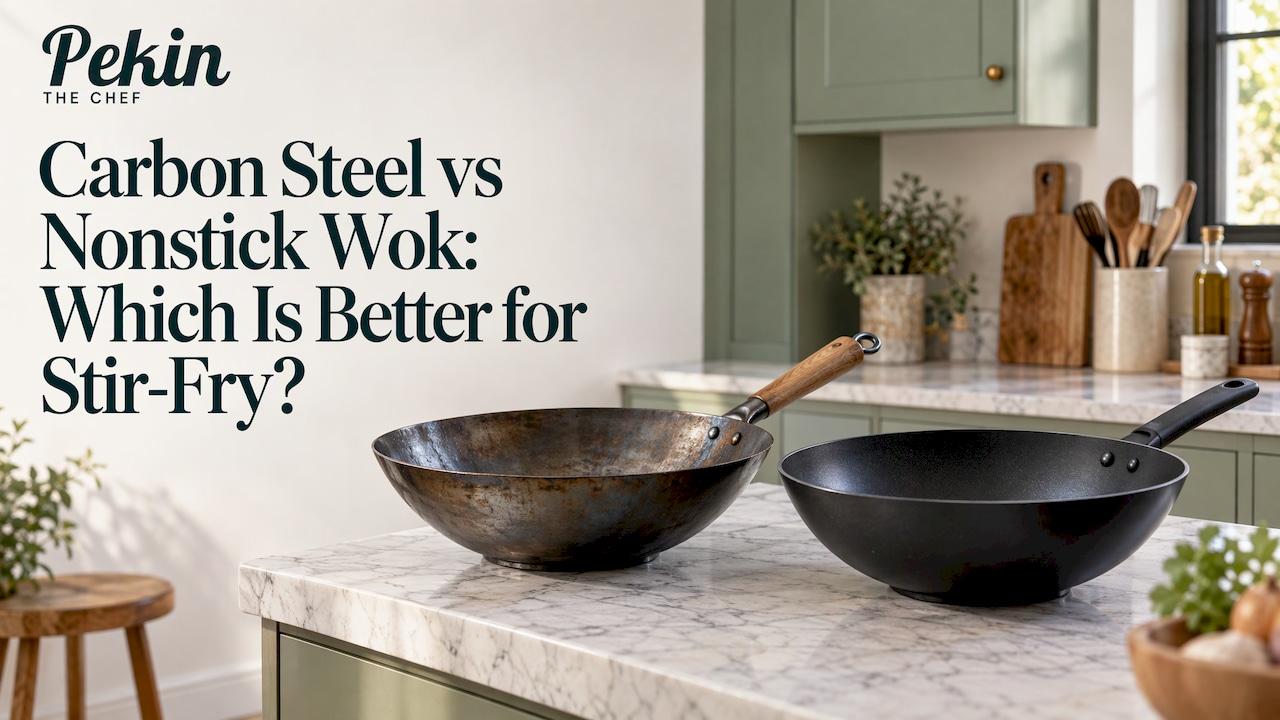
For real stir-frying, carbon steel is the better wok. It tolerates the high heat a stir-fry demands, it builds a natural nonstick seasoning the more you cook, and it can last for decades. A nonstick wok is easier on day one and forgiving for gentle, low-heat cooking, but the coating asks you to keep the burner down, the utensils soft and the expectations modest. At Pek in the Chef, we build our collection around dishes that restaurants make over fierce flame, so the pan you choose shapes how close your kitchen gets to that plate.
This guide walks through how each material behaves, what each one asks of you, how long each lasts, and how to match a wok to your stove and your habits.
TL;DR
- Carbon steel is the classic wok material: it heats fast, cools fast, and gives stir-fries their smoky, seared character.
- Nonstick is simpler at first, but the coating is not meant for the sustained high heat that stir-frying calls for, and it wears out sooner.
- Carbon steel needs seasoning and a little drying and oiling after washing; in return, it grows more slippery with use.
- A flat-bottomed 14-inch carbon steel wok is a strong all-around pick for a typical American home range, including induction.
- Whichever wok you choose, run a range hood while you cook over high heat.
Table of Contents
- The short answer: match the wok to the way you cook
- Why carbon steel suits stir-frying
- Where a nonstick wok shines, and how to use one well
- Heat, flavor and the home stove problem
- Care and cleaning: what each wok asks of you
- Durability and cost over time
- Choosing your wok: a quick decision guide
- Don't forget ventilation
- Cooking in your wok: what to make first
- Where we stand
- Find your next restaurant dish to cook in your wok
- FAQ
- Sources
The short answer: match the wok to the way you cook
The question is less about which material is "best" and more about what you ask the pan to do. A stir-fry is a high-heat technique: small pieces of food, a hot surface, constant motion, a few minutes. Carbon steel was made for that. Nonstick was made for low-to-medium heat, for eggs, delicate fish and quick cleanups.
Here is how the two compare at a glance.
| Factor | Carbon steel wok | Nonstick wok |
|---|---|---|
| High-heat searing | Excellent, built for it | Limited by the coating |
| Smoky, charred flavor | Yes | Hard to achieve |
| Out-of-the-box ease | Needs seasoning first | Ready to cook |
| Utensils | Metal spatula or ladle welcome | Soft utensils only |
| Cleaning | Hot water, no soap, dry and oil | Gentle hand-wash |
| Lifespan | Can last generations with care | Replace when the coating wears |
| Induction compatible | Yes | Depends on the base |
| Best for | Stir-fries, searing, deep-frying | Light, low-heat dishes |
If you cook stir-fry more than once a month and want the sizzle and savor of a restaurant kitchen, carbon steel is the one. The rest of this guide explains why, and how to get past its small learning curve.
Why carbon steel suits stir-frying
Heat that responds quickly
Carbon steel is thin and conducts heat quickly. It heats fast and also cools fast when you take it off the flame, which is exactly what you want when you are tossing garlic, ginger and vegetables and need to control the moment each one hits the pan. Thicker, heavier materials hold heat longer but respond more slowly.
Wok expert Grace Young has described carbon steel as "ancient nonstick cookware" and recommends a flat-bottomed 14-inch carbon steel wok for home cooks, because it maximizes the surface that touches the burner and extracts the most heat from a less powerful range. She also says carbon steel gives stir-fries a smoky, caramelized essence that stainless steel, anodized aluminum and nonstick woks cannot.
That last point matters for flavor. The intense heat at the base of a carbon steel wok drives the browning reactions that give stir-fries their depth: char on the beef, blistered edges on the green beans, a faint smokiness that you associate with a good Chinese restaurant. That is the taste people describe as wok hei, the breath of the wok.
Tough enough for a metal spatula
Stir-frying is physical. You scoop, flip and scrape. Consumer Reports notes that nonstick cooking rules out metal utensils, and that wood and silicone are not thin enough to slide quickly under meat and other ingredients, a point made by Grace Young. Carbon steel has no such restriction. A thin metal spatula or a traditional wok ladle works with the shape of the pan.
J. Kenji López-Alt tells Vogue that he always recommends carbon steel because it is tough, lasts a long time, builds seasoning and gives food a flavor stainless steel cannot. His view of nonstick is that it will not last when you keep going in with a spatula and heating to very high temperatures.
A surface that improves with use
A carbon steel wok does not come with a coating that wears away. It develops a layer of polymerized oil, called seasoning or patina, that gets darker and more slippery each time you cook. Early on, the surface can feel a bit sticky. Over months of regular use it becomes the glossy, near-black finish that experienced cooks prize. Consumer Reports adds that carbon-steel woks can be tricky to clean until they develop a patina from frequent use and occasional seasoning, which is the honest description of the first few weeks.

Works on every cooktop
Carbon steel works on any type of cooktop, including induction, is common for woks, and is lighter than cast iron. That lightness is practical: a wok you can lift with one hand is a wok you can toss, tilt and swirl oil around.
Where a nonstick wok shines, and how to use one well
A nonstick wok earns its place for a particular kind of cook: someone who wants zero fuss, makes mild dishes like scrambled eggs with tomato or steamed-then-sauced fish, and prefers wiping over seasoning. Chef Jeremy Pang, founder of the School of Wok, says nonstick woks were designed for easy cleaning and simple maintenance, and that newer models are increasingly resistant to damage from everyday use and utensils.
If you cook with nonstick, the safe-use rules are straightforward, and they are worth following in full:
- Keep temperatures moderate. Healthline states that current nonstick and Teflon cookware is considered safe for everyday home cooking as long as temperatures do not exceed 500°F (260°C). At very high temperatures, the coating can break down and release fumes that may cause polymer fume fever.
- Never preheat it empty. Consumer Reports explains that wok cooking generally calls for high heat, which some nonstick manufacturers discourage, and that heating a nonstick pan while empty can damage it and increase exposure to harmful fumes.
- Use wooden, silicone or plastic utensils and wash gently by hand. Healthline gives the same guidance, and advises replacing the pan once the coating visibly deteriorates through scratches, peeling, flaking or chipping.
- Ventilate. More on that below.
People with pet birds should be especially careful, since fumes from overheated nonstick coatings are a known hazard to birds; ask your veterinarian about the safest setup for your home.
If you are curious about how nonstick compares with another low-stick option, our guide to ceramic vs nonstick pans covers where each belongs on your stove.
The core trade-off is simple: nonstick asks you to cook at a gentler temperature than a classic stir-fry wants. Consumer Reports also reports that a nationally representative survey found most U.S. adults who cook or bake are at least somewhat concerned about chemicals such as PTFE in cookware, which is one more reason many cooks choose a pan with no coating at all.
Heat, flavor and the home stove problem
Restaurant wok burners put out far more heat than a household range. Consumer Reports says home ranges and cooktops cannot match the heat of local Chinese restaurants. That is the crux of the home stir-fry: you are already working with less heat than the professionals, so a pan that gives some of it away to a coating, or that you must keep below a certain temperature, widens the gap.
Carbon steel closes it in three ways:
- Direct contact. A flat bottom sits flat on a standard burner or induction plate, so the full base gets hot.
- Thin walls. Less metal to heat means the pan reaches searing temperature sooner.
- Recovery. Because the wok heats and cools quickly, you can cook in small batches and let it come back to temperature between them.
On a typical home range, that means cooking meat in batches rather than crowding the pan, which is a habit that also separates restaurant results from home results. Our guide on how to tenderize chicken like a restaurant pairs naturally with this: velveting the meat and searing it in a very hot wok is how a stir-fry gets silky inside and browned outside.
Gas, electric and induction
- Gas: A round-bottomed wok can nest into a wok ring, but a flat-bottomed wok sits stably on any grate and gets more contact with the flame.
- Electric coil or radiant: Choose a flat bottom to maximize contact.
- Induction: Choose carbon steel with a flat base. Consumer Reports confirms carbon steel works with induction. Check that any nonstick wok you consider is marked as induction-compatible.
Care and cleaning: what each wok asks of you
Carbon steel: a five-minute routine
Carbon steel must be seasoned to avoid rusting, and it is not dishwasher-safe, but it wipes clean with paper towels and the routine is short.
To season a new wok:
- Scrub off the factory coating with hot water and a soft sponge, as directed by the manufacturer.
- Heat the wok over high heat until the surface changes color, turning it so the sides heat too.
- Rub a thin layer of a neutral, high-smoke-point oil, such as canola or grapeseed, over the inside.
- Heat until the oil stops smoking, wipe out the excess, and repeat a few times.
A faster way to build seasoning is simply to cook. Stir-fry aromatics such as scallions and ginger with a little oil, then use the pan often. Fatty foods help the patina along in the early weeks.
After each use:
- Rinse with hot water while the wok is still warm and use a soft sponge or brush.
- Skip dish soap where you can, since it is meant to lift oil and can strip a young seasoning.
- Dry it completely, ideally over a burner for a moment.
- Wipe on a very thin layer of neutral oil before storing.
That last step prevents rust, the main failure of carbon steel. If a rust spot appears, scrub it off, re-season, and carry on. The wok is usually recoverable, which is not true of a flaking coating.
Nonstick: easy, but gentle
With nonstick, there is nothing to season. You wash it gently by hand, avoid abrasive scrubbers, never preheat it empty, and keep the heat at medium or low. When the surface scratches, peels or chips, it is time to replace it.
Durability and cost over time
This is where carbon steel quietly wins. Consumer Reports says carbon steel woks are durable while also being thinner and lighter than woks made of other materials, which is why they are popular and a good choice for beginners.
A nonstick wok is a consumable. Any coating degrades with heat and utensil contact, and a worn coating is the end of the pan. A carbon steel wok is closer to a tool you keep: if the seasoning gets damaged, you re-season it. Prices for both types are typically in the same modest range at the entry level, so the real difference shows up over the years. One pan you replace on a cycle, the other you keep and pass along.

There is also the matter of what the pan does for your cooking. Seasoning gets better with every dish. A well-used carbon steel wok becomes more slippery, more flavorful and more personal, while a nonstick pan is at its best on the day you unbox it.
Choosing your wok: a quick decision guide
Choose carbon steel if you:
- Want smoky, seared stir-fries with a restaurant character
- Cook over high heat, on gas, electric or induction
- Use a metal spatula and cook in batches
- Like a pan that improves with age and can be maintained rather than replaced
- Want one pan for stir-frying, searing, shallow frying and deep-frying
Consider a nonstick wok if you:
- Mostly cook gentle, low-heat dishes like eggs or delicate fish
- Want the quickest cleanup and no seasoning routine
- Are willing to keep the heat moderate and use soft utensils
For most readers who landed here asking about stir-frying, the first list is the one that matches. Buy a 14-inch flat-bottomed carbon steel wok with a long handle (and, if you have a lot of counter-height cooking, a helper handle too), and give it a few weeks to settle in.
Don't forget ventilation
High-heat cooking makes smoke, oil vapor and lingering aromas. Consumer Reports advises that if you plan a lot of high-heat cooking such as stir-frying, you should have a good range hood. Turn it on before you start, and keep it running a few minutes after you finish. Open a window if you can.
And if the aroma of a great stir-fry lingers longer than you would like, these tips on how to remove frying smell from your kitchen are a practical follow-up.
Cooking in your wok: what to make first
A new carbon steel wok rewards simple, aromatic dishes. Start with a vegetable stir-fry, a handful of garlic and a splash of oil, and let the pan build its first layer of patina. Then move up to noodles, where the high heat and constant tossing make the difference obvious: our stir-fried noodles recipe is a good first project. For a green side, the bok choy recipe takes just minutes in a hot wok and shows off what a quick sear does for crisp stems.
A few habits will make every stir-fry better, whichever wok you own:
- Prep everything first. Once the pan is hot, the cooking takes minutes.
- Dry your ingredients. Wet food steams instead of searing.
- Cook in batches. Overcrowding drops the temperature.
- Heat the pan before the oil. Add oil, swirl, and add food as it shimmers.
- Keep things moving. Toss and scoop to cook evenly without burning.
Where we stand
Every restaurant recipe we publish starts with a question: what does this dish need from the pan? For stir-fries, noodles and anything seared hard and fast, the answer is nearly always a carbon steel wok. It is the pan professionals reach for, and it is a pleasure to cook in once it has a few weeks of seasoning behind it.
The home cooks who share feedback on our recipes tell us what works in real kitchens, on real stoves, and that is what we care about. A good wok rewards patience: each stir-fry adds to the patina, and each patina adds to the flavor. Pair a carbon steel wok with a recipe vetted by other home cooks, and you have the best chance of tasting something close to what the restaurant serves.
Our advice is simple: pick a 14-inch flat-bottomed carbon steel wok, season it, cook something fragrant, and keep going.
Rhys
Find your next restaurant dish to cook in your wok
Pek in the Chef is a collection of recipes inspired by popular dishes from real restaurants, each one with ratings and feedback from other home cooks. You can search by restaurant, dish, cuisine, meal type or prep time, so it is easy to find a stir-fry, noodle or hot pot recipe that suits your evening. Start on the Pek in the Chef home page, or try the Aki Asian Hotpot chicken recipe.

If you also want to learn the restaurant technique of building a quick sauce in the same pan, our guide to the pan sauce technique shows how fond, deglazing and reduction work together.
FAQ
Is a carbon steel wok better than nonstick for stir-fry?
For traditional high-heat stir-frying, yes. Carbon steel heats quickly, handles metal utensils and develops a natural nonstick seasoning, and wok experts such as Grace Young and Kenji López-Alt recommend it. Nonstick suits gentler, lower-heat cooking.
Can I use a nonstick wok on high heat?
It is best not to. Healthline says nonstick cookware is considered safe for everyday cooking up to 500°F (260°C), and Consumer Reports warns against heating an empty nonstick pan. Keep the heat at medium, add food promptly and ventilate your kitchen.
Is carbon steel hard to take care of?
Not once you have the routine. Season the wok, rinse it with hot water after cooking, dry it fully and wipe on a thin layer of oil. Consumer Reports notes it wipes clean easily and gets easier to manage as the patina develops.
What size and shape of wok should I buy for a home stove?
A flat-bottomed 14-inch carbon steel wok is Grace Young's recommendation for home ranges, because it puts the most surface in contact with the burner. Carbon steel also works on induction, so the same pan suits gas, electric and induction cooktops.
Sources
- Wok master Grace Young shares secrets of great stir-frying, The Oregonian
- Best Cookware Buying Guide, Consumer Reports
- Buying a Wok: What to Look for in a Wok, Consumer Reports
- Is Nonstick Cookware Like Teflon Safe to Use? Healthline
- J. Kenji López-Alt Explains Why a Wok Is the Only Pan You Need, Vogue
- How to season a wok according to TV chef Jeremy Pang, The Independent