
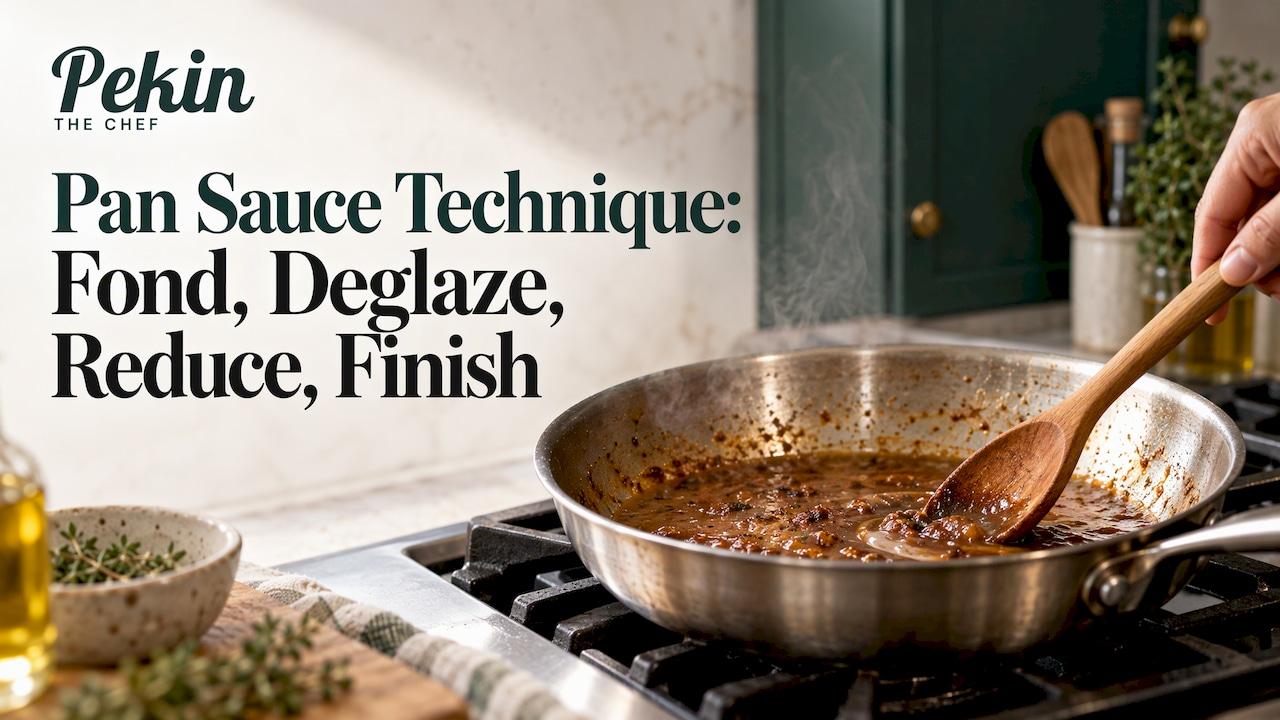
A pan sauce is the quickest route to a restaurant-style plate: you sear a protein, then use the browned bits stuck to the pan, called fond, as the foundation of a sauce that takes about five minutes. The technique has four moves, which are sear, deglaze, reduce and finish. Once your hands know them, a steak, a chicken thigh, a pork chop or a seared fillet can each get its own sauce from the same skillet.
TL;DR
- Sear first, in a pan that lets browned bits build up (stainless steel or cast iron), and keep those bits. They are the flavor.
- Deglaze with about a half cup of wine, stock, vinegar or spirits, scraping as the liquid bubbles, then reduce until it coats a spoon.
- Pull the pan off the heat and swirl in cold butter a piece at a time for a glossy finish that does not turn greasy.
- If the sauce splits, lower the heat, add a spoonful of warm liquid or a cold cube of butter, and whisk or swirl until it comes back together.
- Cook the protein to a safe internal temperature before you serve it, whatever the sauce.
Table of Contents
- What a pan sauce really is
- Step 1: Build the fond
- Step 2: Add aromatics and deglaze
- Step 3: Reduce until it coats a spoon
- Step 4: Finish with fat, acid and herbs
- Three styles of pan sauce
- Why a pan sauce breaks, and how to fix it
- Pairings to try with your pan sauce
- Common mistakes
- Our perspective
- Bring the technique to your kitchen
- FAQ
- Sources
What a pan sauce really is
A pan sauce is built in the same pan that cooked the protein, with fond, the crispy bits left on the bottom, as its foundation. The basic formula is simple: sear the protein, loosen the fond with liquid, then stir and swirl until the sauce is smooth and emulsified.
The Institute of Culinary Education describes the core sequence as three transferable techniques: creating fond, deglazing to bring it into the sauce, and reducing to refine flavor and texture. That framing is useful because nothing in it is tied to chicken. The same three moves work on other proteins and on cooked vegetables.
What you taste in a good pan sauce is concentration. Browning creates deep, savory, slightly sweet flavors on the pan surface, the liquid carries them off, and reduction condenses them. A pan sauce is not a gravy and it is not a stew. It is a small, intense spoonful meant to sit under or beside the food, and restaurants lean on it constantly because it costs almost nothing and makes a plate look finished.

Step 1: Build the fond
Everything depends on the browning, so set the pan up for it.
- Choose the right pan. Stainless steel and cast iron release fond willingly into liquid. A dark nonstick surface tends to brown less, which leaves you less to deglaze.
- Dry the protein. Pat it with paper towels and season generously. Surface moisture steams the meat and delays the browning you want.
- Use a pan sized to the food. Crowding drops the temperature and floods the pan with juices, which can leave you with pale meat and no fond.
- Heat the fat first. Use a high-smoke-point oil such as avocado or canola. Add the protein when the oil shimmers.
- Leave it alone. Let the protein release naturally from the pan before turning it. Moving it early tears the crust.
You are aiming for fond that is deep golden to mahogany brown. Blackened, bitter bits will flavor the sauce the same way, so if the pan smokes heavily and the bottom looks scorched, pour off the fat, wipe the pan and begin again with a splash of liquid and a fresh start.
Rest the protein while you work
Once the protein is cooked, move it to a plate and loosely cover it. Resting gives the juices time to settle, and it frees the pan. Cook to a safe temperature with a thermometer: the USDA's safe minimum internal temperature chart lists 165°F for poultry, 160°F for ground meats and 145°F for whole cuts of beef, pork and fish, with a rest time for the whole cuts of beef, pork and lamb. If the protein is still short of its target, finish it in a 400°F oven or return it to the sauce for a minute or two.
Step 2: Add aromatics and deglaze
Pour off all but about a tablespoon of fat. Lower the heat to medium. Now is the moment for aromatics: a minced shallot is the classic choice, with garlic added in the last 20 seconds so it does not scorch. Cook them for a minute or so, until soft and fragrant.
Pick your deglazing liquid
Deglazing means adding liquid to a hot pan so the fond dissolves into it. Different liquids bring different personalities:
| Liquid | What it brings | Good with |
|---|---|---|
| Dry white wine | Bright acidity, clean fruit | Chicken, pork, fish, scallops |
| Dry red wine | Depth, tannin, dark fruit | Steak, lamb, duck |
| Brandy, bourbon or cognac | Warm, caramel notes (add off heat, away from open flame) | Steak, pork chops |
| Chicken or beef stock | Savory body, no sharpness | Everything, especially when you skip alcohol |
| Sherry or wine vinegar | Sharp acid, balances rich fats | Duck, pork, sausages |
| Lemon juice or verjus | Fresh tartness | Fish, chicken cutlets, vegetables |
A practical measure is about a half cup of liquid for a skillet that cooked two to four portions. Pour it in and scrape the bottom with a wooden spoon or flat-edged spatula. The fond should lift within seconds, and the liquid will turn the color of the browning.
If you use spirits, take the pan off the burner before pouring. High-proof alcohol can ignite on contact with a flame or very hot element, and gas ranges are the usual culprit. Return the pan to the heat once the liquid is in.
Wine, stock or both?
A common pattern is to deglaze with wine first, let it reduce by about half to cook off the raw alcohol edge, then add stock for body. Wine alone can taste thin or sharp in a sauce, while stock alone can taste flat. Together they are balanced. If you cook without alcohol, use stock with a small splash of vinegar or lemon juice added at the end to bring back the brightness that wine would have provided.
Step 3: Reduce until it coats a spoon
Reduction is the step most beginners rush. Simmer the liquid briskly, scraping occasionally, until the volume falls by roughly half to two thirds. The classic test, which Hestan Cue describes for reduction sauces, is to reduce until the liquid coats the back of a spoon.
Here is how to read it in the pan:
- Bubbles get bigger and slower. Fast, small bubbles mean there is still a lot of water.
- A spoon test works. Dip a spoon, draw a finger across the back, and see whether the line holds. If it does, the sauce is ready.
- The pan bottom shows a trail. Drag a spatula across and watch the sauce slowly close behind it.
- Taste it. If it is intensely salty, you have reduced too far or used salty stock. Add a splash of water, unsalted stock or wine to rebalance.
Salt carefully. Reduction concentrates what is already in the liquid, so taste before you add any, and season at the very end.
When you do not want to reduce as far
Sometimes you want body without long evaporation, particularly with a lean cut that is already resting. Hestan Cue also notes that thickened reductions use roux, beurre manié or cornstarch in place of pure evaporation. Beurre manié is equal parts soft butter and flour kneaded into a paste and whisked in a little at a time. A cornstarch slurry, a teaspoon of starch stirred into a tablespoon of cold water, is the fastest fix and gives a glossier finish. Whisk either in while the sauce simmers, and cook for a minute so no raw starch taste remains. We cover the same logic for another sauce family in our guide on how to thicken curry.
Step 4: Finish with fat, acid and herbs
This is where a good sauce becomes a great one. With the pan off the heat, or at the lowest possible heat, add two to four tablespoons of cold butter, cut in small cubes, one or two at a time. Swirl the pan or whisk steadily until each piece has melted before adding the next. The sauce thickens slightly, takes on a sheen and tastes rounder.
Temperature is the whole game. Cold butter melts slowly and its milk solids, water and fat come together into a creamy emulsion. If the pan is too hot, the butter simply melts into a slick of oil on top.
Next, brighten and season:
- A teaspoon of Dijon mustard also helps hold the emulsion together, and it adds a gentle tang.
- A squeeze of lemon or a splash of vinegar wakes up a sauce that tastes heavy.
- Capers, chopped cornichons or olives bring a briny edge to chicken and fish.
- Soft herbs such as parsley, chives or tarragon go in last, off the heat, so they stay green.
- Any juices that collected under the resting protein belong in the pan too. Stir them in just before serving.
Taste, adjust salt and pepper, and spoon the sauce over or beside the protein straight away. A pan sauce does not wait well.
Three styles of pan sauce
The same method can lead to different results depending on how you finish. The Hestan Cue guide groups pan sauces into reduction, brown butter and emulsion styles, and that gives a helpful map.
Reduction sauce
Deglaze, reduce with stock, and stop. This is the leanest option and the most direct expression of the fond: a thin, concentrated, glossy sauce. It suits steak, lamb and duck. A finishing knob of butter is optional.
Cream sauce
After reducing the wine, add heavy cream and simmer until it coats a spoon. Peppercorns, mustard or a spoonful of tomato paste early on give you steakhouse-style variations. Cream is more forgiving than butter because it holds together under heat, so it is a good first sauce for cooks nervous about splitting.
Butter emulsion
For a butter emulsion such as beurre blanc or beurre monté, the approach is to reduce wine, vinegar, stock and aromatics to a concentrated base, then slowly whisk in butter off the heat. The result is pale, silky and tangy, a natural partner for scallops, fish and vegetables. It is also the sauce most likely to separate, so keep the pan warm rather than hot and add the butter slowly. If you want to see seared seafood treated with restraint, our diver scallop recipe from 53 and the diver scallops from Aba Austin are both good places to practice.
Why a pan sauce breaks, and how to fix it
A broken sauce separates into a watery layer and an oily film. Almost every cause is temperature or speed, which makes it fixable.
- The pan was too hot when the butter went in. The fat melts out and floats.
- The butter went in too fast. The liquid cannot absorb it quickly enough to form an emulsion.
- The base was reduced too far. There is too little water left to hold the fat, and the sauce turns thick and greasy.
- The sauce sat. A butter sauce held over heat for long will separate.
Here is the repair, in the order we would try it:
- Take the pan off the heat right away.
- Add a tablespoon of warm water, stock or cream, and whisk hard. Often that alone is enough.
- If it is still split, whisk in a cold cube of butter or an ice cube, and keep whisking.
- For a stubborn split, start a fresh tablespoon of cream or water in a clean pan over low heat and whisk the broken sauce into it a few drops at a time, as though you were making mayonnaise.
- Serve soon. A repaired sauce is fragile.
A sauce that is simply too thin needs more reduction or a pinch of starch. A sauce that is too thick takes a splash of stock. One that tastes too sharp wants a little butter, a pinch of sugar or more stock. One that tastes flat needs salt first and acid second.
Pairings to try with your pan sauce
The method does not change, only the pairing does. Here are combinations that work:
- Steak: red wine, shallot, beef stock, thyme and butter. See how a steakhouse plate comes together in the steak frites at 84 Italian Steakhouse or the prime NY steak frites at 224 Boston.
- Chicken: white wine, chicken stock, lemon, capers and parsley. A good reference for a bone-in, skin-on bird is the pan roasted chicken from 1928 Beacon Hill.
- Pork chops: apple cider, Dijon mustard, sage and a splash of cider vinegar.
- Fish and scallops: dry vermouth or white wine, shallot, lemon and chives, finished with butter.
- Duck: sherry vinegar, port and stock, reduced hard.
For ideas on adapting the method to different proteins in a weeknight format, these high-protein family dinners show how quick one-pan cooking can work across a range of ingredients.
Beyond meat and fish
Fond is not only a meat phenomenon. Mushrooms, cauliflower steaks, cabbage wedges and roasted beets all brown and leave flavorful residue. Deglaze with vegetable stock, white wine or a splash of vinegar, reduce, and finish with butter or olive oil. The same principle of concentrating flavor shows up in lighter preparations, such as these quick sauces for bowls, which are a useful reminder that a good sauce can brighten grains, vegetables and plant-based proteins as well. For a vegetable-led dish plated like fine dining, take a look at Acquerello's dry-aged beetroot.
Common mistakes
- Starting with a wet protein. No browning, no fond.
- Washing the pan. The residue is the flavor, so never rinse before deglazing.
- Adding cold liquid to a screaming hot pan with your face over it. Pour from the side and step back, because steam and spirits flare.
- Skipping the reduction. Unreduced wine tastes raw and sharp.
- Salting early. Reduction concentrates salt.
- Boiling after the butter goes in. Keep it warm, not bubbling.
- Using too much liquid. A pan sauce is meant to be small. Half a cup reduced is enough for several plates.
Our perspective
Pan sauces are the perfect example of why we started cooking from restaurant dishes. A line cook does not have time for a long stock or a pantry of specialty ingredients. They have a hot pan, a splash of something, a knob of butter and a good sense of timing. That is a technique a home cook can learn in an evening, and it is what we hope you take from every recipe we feature.
The community is the second ingredient. When a recipe on our site gets ratings and comments from other home cooks, you can see where the sauce tends to break, which wine people swapped in, and how long the reduction really took on a home burner. We think that feedback is what turns a restaurant idea into something you can trust on a Tuesday night.
Start with one protein and one sauce. Cook it three times. By the third, you will stop measuring and begin tasting, and that is when a recipe becomes your own.
Rhys
Bring the technique to your kitchen
If you would like to see these moves applied to real restaurant plates, our collection is organized by restaurant, dish, cuisine, meal type and prep time, with feedback from other home cooks on each recipe. Search for a steak, chicken or seafood dish, read what others changed, and cook it with a pan sauce of your own.

Browse recipes inspired by your favorite restaurants, or start with the kung pao chicken from 53 to practice building a glossy sauce quickly. Some recipes include links to kitchen tools and ingredients we like, which is how we keep the site running.
FAQ
How do you make a pan sauce?
Sear a protein in a skillet and set it aside to rest. Cook a minced shallot in the leftover fat, deglaze with about a half cup of wine or stock, and reduce until the liquid coats a spoon. Off the heat, swirl in a few cubes of cold butter, add herbs and a squeeze of acid, and taste for salt.
What can I use to deglaze a pan?
Wine, stock, brandy, bourbon, vinegar, cider and citrus juice all work. Wine and stock are the most versatile, and stock with a splash of vinegar is a good alcohol-free option. Add spirits off the heat, since they can flare.
Why did my pan sauce turn greasy or split?
Usually the pan was too hot when the butter went in, or the butter was added too quickly. Take it off the heat, whisk in a spoonful of warm water, stock or cream, and add a cold cube of butter if needed. Next time, keep the heat low and add the butter a piece at a time.
Can I make a pan sauce without butter?
Yes. A reduction of wine and stock is a classic sauce on its own, and olive oil, cream or a small amount of mustard can give body. A teaspoon of cornstarch in cold water thickens it quickly if you do not want to reduce as far.
Sources
- How to Make an Easy Pan Sauce, Made In
- How to Make a Pan Sauce to Pair with Any Protein, Institute of Culinary Education
- Complete Guide to Pan Sauces, Hestan Cue
- Safe Minimum Internal Temperature Chart, USDA FSIS
- 30 Minute One Pan and No Cook High Protein Family Dinners
- Four Light Bowl Sauces for Texture and Protein