
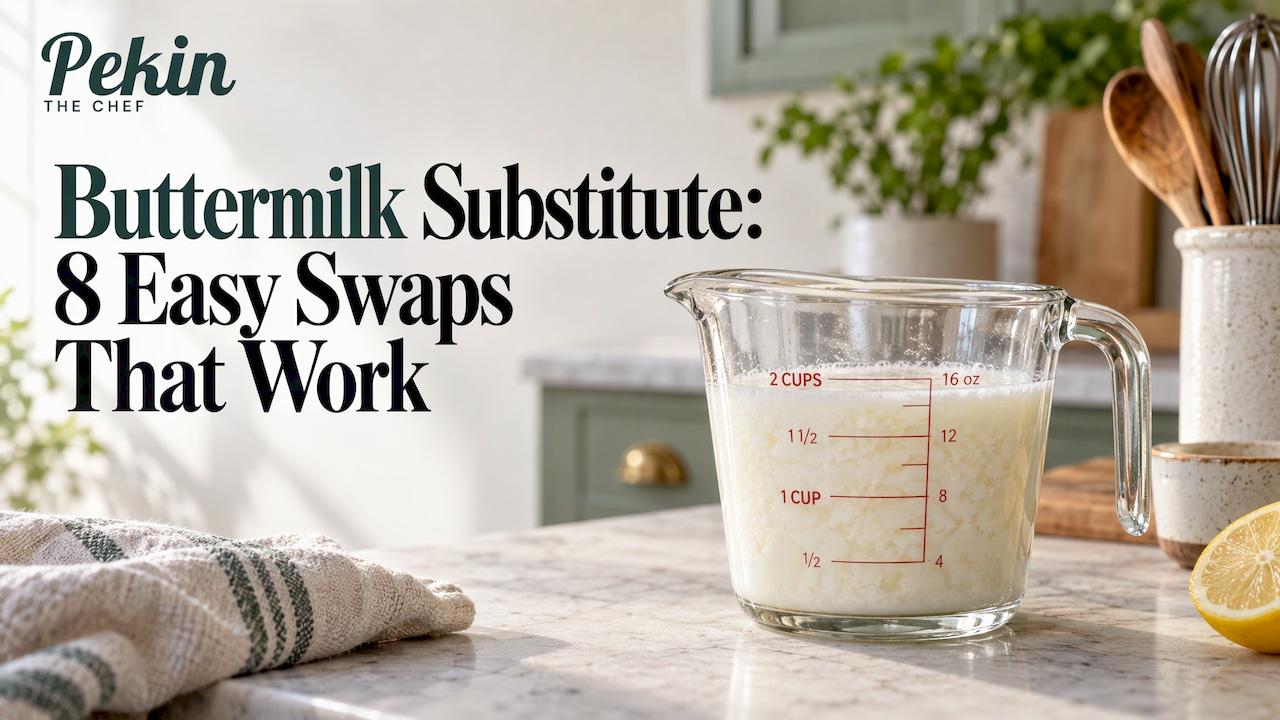
The best buttermilk substitute is already in your kitchen: one tablespoon of lemon juice or white vinegar, stirred into a liquid measuring cup and topped with milk to the 1-cup line. Five minutes later you have a tangy, lightly curdled stand-in that wakes up baking soda the way real buttermilk does. Yogurt, sour cream, kefir and a few dairy-free options cover everything else, and each one has its own ratio and its own best use.
Below you will find every swap with its exact measurements, what each does to a pancake, biscuit or batch of fried chicken, and how to store what is left over.
TL;DR
- Any buttermilk swap needs two things: acidity and a liquid close to buttermilk in body. Milk plus 1 tablespoon lemon juice or white vinegar per cup is the classic answer.
- Thick swaps, such as sour cream or yogurt, must be thinned with milk or water to pour like buttermilk: about 3/4 cup sour cream plus 1/4 cup liquid per cup.
- Plain kefir swaps in cup for cup, and unsweetened soy milk with an acid is the most dependable dairy-free route.
- Regular milk on its own is not a swap. Without acid, pancakes and biscuits bake up flatter.
- Mix a batch only for what you need, and refrigerate leftovers within 2 hours.
Table of Contents
- What buttermilk actually does in a recipe
- The five-minute swap: milk and acid
- Every swap at a glance
- Sour cream, yogurt and kefir: the cultured swaps
- Dairy-free buttermilk substitutes
- Buttermilk substitute for fried chicken
- Matching the swap to what you are baking
- Storing leftovers safely
- Find your next restaurant-style recipe
- FAQ
- Sources
What buttermilk actually does in a recipe
To choose a good stand-in, it helps to know the job you are replacing. Cultured buttermilk is tangy because of lactic acid, and that acid does the heavy lifting. According to the American Society of Baking, lactic acid reacts with baking soda to release carbon dioxide, which leavens biscuits, scones, soda breads, quick breads, pancakes, waffles, muffins and cakes. The same page notes that buttermilk also contributes moisture, crumb, texture, browning and flavor.
That reaction is the reason a recipe pairs buttermilk with baking soda. A college chemistry kitchen post on buttermilk pancake science explains that the acid and soda form tiny air pockets, and that plain milk with no added acid gives noticeably flatter pancakes. So the lesson is simple: whatever you swap in must bring acid, and it should pour about as thickly as buttermilk does.
Healthline's registered dietitian reaches the same conclusion in her guide to 14 substitutes: the key elements are acidity plus a liquid similar to buttermilk. Keep those two ideas in mind and you can improvise with confidence.

The five-minute swap: milk and acid
This is the version most home cooks reach for, and it is the one to learn first. The University of Maine Cooperative Extension gives the method for homemade buttermilk in a few plain steps.
Step by step
- Pour 1 tablespoon of lemon juice or white vinegar into a liquid measuring cup.
- Add milk until the liquid reaches the 1-cup mark.
- Stir once, then let it stand for 5 to 10 minutes, until light curdling appears.
- Stir again and use it right away, measure for measure, in place of buttermilk.
A few details make the difference between a good result and a so-so one.
Use a liquid measuring cup, not a dry one. Adding the acid first and then filling with milk keeps the total at exactly one cup. If you pour the milk first and add the acid on top, you end up slightly over.
Any milk works. The extension recipe notes that cow's, nut, oat and soy milk all work, and so does any fat percentage. Whole milk gives a richer, rounder result, which is lovely in pancakes and cakes. Lower-fat milk still gives you the acid your baking soda needs.
The wait is flexible. Healthline notes that experts say the 5 to 10 minute rest is not strictly necessary, although the mixture curdles quickly. If you are mid-recipe, mixing it with your wet ingredients while you measure the dry ones is a sensible way to use the time.
Lemon or vinegar? Both bring the acid. Distilled white vinegar is the more neutral of the two, so it is the one to choose when you do not want a hint of citrus in, say, a vanilla cake or a plain biscuit. Lemon juice adds a faint brightness that suits lemon scones, blueberry muffins and pancakes.
Cream of tartar
If you bake often, cream of tartar is a pantry staple worth keeping. Healthline's ratio is 1¾ teaspoons (5 g) of cream of tartar per cup of milk. Because the powder clumps in cold liquid, mix it with your dry ingredients, or whisk it first into 2 tablespoons of the milk before adding the rest.
Every swap at a glance
Here are the ratios from the sources above, gathered into one table. All amounts replace 1 cup of buttermilk.
| Swap | How to make 1 cup | Best for |
|---|---|---|
| Milk + lemon juice or white vinegar | 1 tablespoon acid, then milk to the 1-cup line; rest 5 to 10 minutes | Pancakes, waffles, muffins, cakes, biscuits |
| Milk + cream of tartar | 1¾ teaspoons cream of tartar mixed into the dry ingredients, plus 1 cup milk | Baking where you want no liquid acid flavor |
| Sour cream, thinned | 3/4 cup sour cream plus 1/4 cup water or milk | Cakes, quick breads, dressings |
| Plain yogurt, thinned | 6 oz plain yogurt plus 1/4 cup water or milk | Muffins, marinades, pancakes |
| Plain kefir | 1 cup, cup for cup | Almost anything |
| Unsweetened soy milk + acid | 1 cup soy milk plus 1 tablespoon lemon juice or vinegar | Dairy-free baking |
| Vegan sour cream, thinned | 1/2 cup vegan sour cream plus 1/2 cup water | Dairy-free cakes and breads |
| Silken tofu, puréed | 1/4 cup silken tofu blended with 3/4 cup water and 1 tablespoon vinegar or lemon juice | Dairy-free, egg-free-minded baking |
Sour cream, yogurt and kefir: the cultured swaps
These three are fermented, so they already carry the lactic tang that makes buttermilk special. Their only drawback is thickness, which is easy to fix.
Sour cream is rich and mellow. Whisk 3/4 cup of it with 1/4 cup of water or milk until it pours smoothly. It makes an especially tender crumb in cakes and quick breads. If you are curious how restaurant kitchens use it, our collection includes 440 Main's sour cream recipe and Alas de Frida's sour cream recipe, both good for seeing sour cream as a star rather than a stand-in.
Plain yogurt is a touch sharper. Use 6 ounces thinned with 1/4 cup of water or milk. Choose plain, unsweetened yogurt, since a flavored cup will send your pancakes in a strange direction.
Plain kefir is the easiest of all. It is naturally pourable and tangy, so you can swap it cup for cup with no thinning and no waiting.

Dairy-free buttermilk substitutes
Families cooking around a dairy allergy or lactose intolerance can still get that tang. The key, again, is acid plus a liquid with some body.
- Unsweetened soy milk is the most reliable, because its protein thickens and curdles like dairy milk when acid is added. Use 1 tablespoon of lemon juice or vinegar per cup, or the 1¾ teaspoons of cream of tartar.
- Oat or nut milk also works in the extension method, though the curdling is subtler.
- Vegan sour cream thinned with water, half and half, gives a creamy result for cakes and breads.
- Silken tofu blended smooth is a surprising performer: 1/4 cup tofu, 3/4 cup water and 1 tablespoon vinegar or lemon juice.
Choose unsweetened and unflavored versions every time. If you want ideas for building a whole dairy-free dinner around the swap, these lactose-free meal options are a good place to browse.
Buttermilk substitute for fried chicken
In fried chicken, buttermilk plays a different role from the one it has in a pancake. You are not trying to make anything rise. The tangy soak seasons the meat, keeps it juicy and gives the flour coating something to cling to. That makes this the most forgiving use of all, and nearly every swap above works.
The simplest route is the milk-and-acid mix: 1 tablespoon of lemon juice or white vinegar per cup of milk, rested for a few minutes. Plain yogurt or kefir thinned to a pourable consistency also works nicely, and sour cream loosened with a splash of milk gives a richer soak.
Some practical pointers:
- Make enough. Use enough liquid to cover the pieces fully in a bowl or zip-top bag. For a family-size batch of chicken, that usually means two to three cups, so scale the ratio up, keeping 1 tablespoon of acid for every cup.
- Season the soak. Salt, black pepper, garlic powder and a dash of hot sauce all dissolve into the liquid and flavor the meat from the inside.
- Let it rest in the refrigerator. Keep raw chicken cold the whole time it soaks, never on the counter.
- Drain, but do not rinse. Let the excess drip off, then dredge in seasoned flour. The clinging bits of cultured liquid help build those craggy, crunchy ridges.
- Cook to a safe temperature. The USDA lists 165°F as the safe internal temperature for poultry, so check with a food thermometer at the thickest part.
The soak is discarded after the chicken has been in it, since it has touched raw meat. Do not reuse it as a sauce or save it for another recipe.
Restaurant-style crunch has a lot to do with technique as well as the soak, from the flour seasoning to oil temperature. Browsing the restaurant recipe collection lets you see how different kitchens approach their coatings and read what other home cooks found when they tried them.
Matching the swap to what you are baking
Pancakes and waffles
These lean hardest on the acid-and-soda reaction, so a precise swap matters. Milk with lemon juice or vinegar is the dependable choice, and kefir or thinned yogurt gives an extra tang. Mix the batter gently and leave a few lumps, then cook right away so the bubbles are still active. If you would like a finished target to aim at, try 224 Boston's buttermilk pancakes, the IHOP pancakes copycat, or 75 Chestnut's Beacon Hill waffles.
Biscuits and scones
Biscuits want cold fat and quick handling, and a cold, thick swap suits them. Thinned sour cream or yogurt gives a tender, slightly tangy crumb, while soured milk works well too. Keep everything chilled until the oven. For inspiration, look at 300 East's egg and cheese biscuit, Alpha Charlie Grill's biscuit plate and 211 Clover Lane's lemon currant scones, where a lemon-based swap would fit right in.
Cakes, muffins and quick breads
Here moisture and crumb matter most. Whole milk soured with vinegar, or thinned sour cream, delivers a soft, even texture. Use vinegar in vanilla or chocolate cakes so no citrus note sneaks in.
Dressings, dips and marinades
No leavening is involved, so flavor is your only guide. Thinned yogurt or sour cream gives the creamiest result, and soured milk works when you want something lighter.
Storing leftovers safely
If you mixed more than you needed, the extension guidance is to refrigerate the leftover within 2 hours and use it within 4 days. Label the jar with the day you made it. Because the soak for raw chicken is a separate matter, never pour that back into the jar.
Our take on swapping buttermilk
We think the best kitchen shortcuts are the ones you understand. A buttermilk swap is not a compromise when you know what the original was doing: bringing acid to react with baking soda, and body to keep the batter tender. Once you see that, a splash of lemon and a cup of milk stops feeling like a workaround and becomes a technique.
That is how we approach every recipe on Pek in the Chef. Each one is inspired by a real restaurant dish, and each comes with feedback from other home cooks, so you can see how a substitution actually turned out in someone else's kitchen before you commit your own breakfast to it.
Next time a recipe calls for buttermilk and the carton is empty, reach for the lemon, trust the chemistry, and enjoy the pancakes.
Rhys
Find your next restaurant-style recipe
Pek in the Chef gathers recipes inspired by popular restaurant dishes, searchable by restaurant, dish or cuisine and sorted by meal type and prep time, with ratings and feedback from home cooks on each one. If a buttermilk pancake, biscuit or scone is what sent you searching, start with the full collection at Pek in the Chef.

FAQ
What can I use if I don't have buttermilk?
Stir 1 tablespoon of lemon juice or white vinegar into a measuring cup, then add milk to the 1-cup line and let it stand 5 to 10 minutes. Thinned plain yogurt, thinned sour cream and plain kefir also work. For a dairy-free option, use unsweetened soy milk with the same amount of acid.
What happens if I use regular milk instead of buttermilk?
Your batter loses the acid that activates baking soda, so pancakes and biscuits come out flatter and a little less tender. Adding lemon juice or vinegar to the milk restores that reaction and fixes the problem.
How do I make 1 cup of buttermilk?
Measure 1 tablespoon of lemon juice or white vinegar into a liquid measuring cup, fill to 1 cup with milk, stir, and wait until light curdling shows. Alternatively, mix 1¾ teaspoons of cream of tartar into your dry ingredients and add 1 cup of plain milk.
Can I use yogurt or sour cream instead of buttermilk?
Yes, but thin them first. Use 3/4 cup of sour cream plus 1/4 cup of water or milk, or 6 ounces of plain yogurt plus 1/4 cup of water or milk. Each makes 1 cup and pours much like buttermilk.
Is there a good buttermilk substitute for fried chicken?
Milk soured with lemon juice or vinegar is the easiest, and thinned yogurt or kefir works just as well. Season the liquid, keep the chicken refrigerated while it soaks, and cook it to 165°F inside.
Sources
- 14 Substitutes for Buttermilk, Healthline
- Buttermilk, University of Maine Cooperative Extension
- Buttermilk, American Society of Baking
- The Science of Buttermilk Pancakes, Dickinson College