
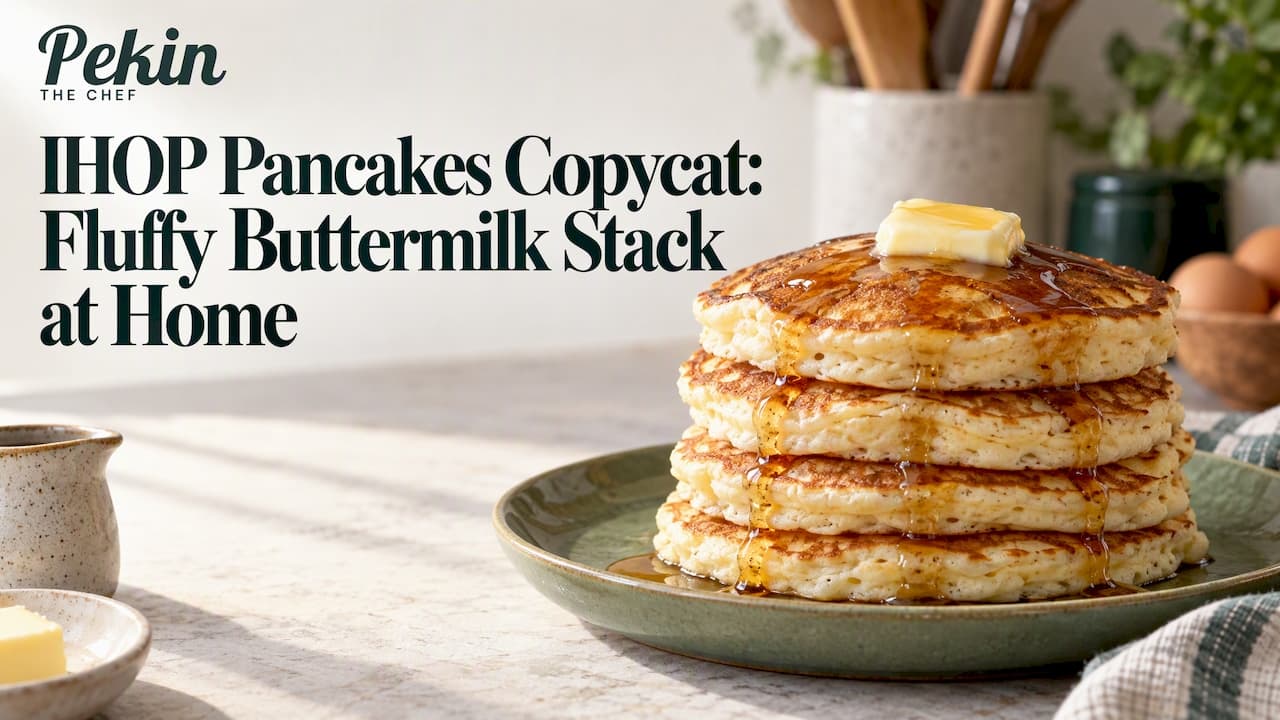
A great IHOP-style pancake is tall, tender and springy, with a golden surface and a faintly tangy, buttery flavor, and you can make one in your own kitchen in about 25 minutes. The secret is not a single mystery ingredient. It is real buttermilk, cold wet ingredients, a lightly mixed lumpy batter and a properly hot griddle. Below you will find our copycat-style recipe, the reasoning behind every step, substitutions for when the fridge is short on buttermilk, and how to keep a batch fresh.
TL;DR
- Use real buttermilk, cold eggs and cold dairy, and stir the batter only until the flour disappears. Small lumps are a good sign.
- Cook on a medium-hot, lightly greased griddle: flip when bubbles form and the edges look dry, then give the second side about a minute.
- No buttermilk? Thinned Greek yogurt or plain kefir works better than the milk-and-vinegar shortcut.
- Keep finished pancakes warm in a 200°F oven, and refrigerate leftovers, covered, for up to 5 days.
- This is our own copycat-style recipe, built around the techniques diner cooks use, not IHOP's secret formula.
Table of Contents
- Why restaurant pancakes taste different from home pancakes
- What you need for copycat IHOP-style pancakes
- How to make the pancakes, step by step
- Timing at a glance
- The common mistakes that make pancakes flat or rubbery
- No buttermilk? Substitutes that actually work
- Variations worth trying
- Our perspective: the pancake is a technique, not a secret recipe
- Keep cooking: more restaurant-inspired breakfasts
- Serving and storing leftover pancakes
- FAQ
- Sources
Why restaurant pancakes taste different from home pancakes
Anyone who has cooked a weekend batch from a box and then sat down to a stack at a diner knows the gap. The restaurant version rises higher, eats softer and carries a gentle tang that the home version often lacks. The reasons are mostly about technique and ingredients, not magic.
According to a Tasting Table report on why restaurant pancakes taste better, the difference comes down to real buttermilk, hot griddles and ice-cold wet ingredients. The same piece quotes IHOP's vice president of culinary innovation, Marie Grimm, explaining that cold wet ingredients keep the flour's gluten from heating up too early, which gives IHOP-style pancakes their springy bounce.
Texture matters as much as flavor. Ed Levine's golden rules of the perfect pancake call for crisp, lacy edges and a light, tender center, and that is a useful target when you are standing at the stove.
And then there is the tang. Bon Appétit explains that buttermilk's acidity reacts with baking soda to make bubbles, and that milk-and-vinegar stand-ins tend to be thin and watery, without the complex tang of the real thing. Hold on to that point, because it shapes the whole recipe.

What you need for copycat IHOP-style pancakes
This recipe makes about 8 to 10 pancakes, each roughly 4 to 5 inches across, enough for three or four people. It uses pantry staples plus buttermilk.
Ingredients
- 2 cups (about 250 g) all-purpose flour
- 2 tablespoons granulated sugar
- 2 teaspoons baking powder
- 1/2 teaspoon baking soda
- 1/2 teaspoon fine salt
- 1 3/4 cups cold buttermilk
- 2 large eggs, cold
- 3 tablespoons unsalted butter, melted and slightly cooled
- 1 teaspoon vanilla extract (optional, but it adds that bakery-sweet note)
- Neutral oil or butter for the griddle
- Soft butter and warm maple syrup, to serve
Why each ingredient is there
Flour. Plain all-purpose flour gives a tender crumb without the chew of bread flour. Spoon it into the measuring cup and level it off rather than scooping, or the batter turns heavy.
Baking powder and baking soda. Both do work here. The soda reacts with the buttermilk's acid immediately, and the powder keeps lifting the pancake as it hits the heat. The Wired explainer on the science of pancakes notes that the bubbles come from baking soda reacting with buttermilk to release carbon dioxide, so you want to cook the batter promptly before they escape.
Buttermilk. This is the flavor backbone. It brings tang, tenderness and the lift described above.
Melted butter. It gives richness and a faint golden flavor. Let it cool for a few minutes so it does not scramble the eggs.
Sugar. Just two tablespoons. Diner pancakes are not sweet on their own, because the syrup does that job.
How to make the pancakes, step by step
1. Chill the wet ingredients
Take the buttermilk and eggs straight from the refrigerator. If your butter is freshly melted, let it cool until it is just warm to the touch, then whisk it into the cold buttermilk and eggs so it does not melt the mixture. This is the cold-batter principle from the restaurant cooks quoted above, and it is the single easiest upgrade to a home stack.
2. Whisk the dry ingredients
In a large bowl, whisk the flour, sugar, baking powder, baking soda and salt for about 20 seconds. Make a well in the center. Whisking the dry ingredients evenly spreads the leavening, which prevents bitter pockets of baking soda and pale, flat patches.
3. Combine, gently
Pour the wet mixture into the well and fold with a spatula or a whisk, using as few strokes as you can. Martha Stewart's buttermilk pancake recipe advises against overmixing and says the batter should keep small to medium lumps. Stop when you no longer see dry streaks of flour. The batter will look thick and a little shaggy, and that is exactly right.
4. Rest it for five minutes
Let the bowl sit while the griddle heats. The flour hydrates, the batter thickens slightly and the first bubbles begin to form. Do not rest it for much longer than 10 minutes, since the leavening starts to fade.
5. Heat and grease the griddle
Set a griddle or large nonstick skillet over medium heat for a few minutes. Brush on a thin film of oil or butter and wipe off the excess with a paper towel, so the surface looks barely glossy. A flick of water should skitter and sizzle. If you cook with an electric griddle, we aim for about 350°F to 375°F, though every appliance runs a little differently, so make the first pancake a test.
6. Pour and cook
Scoop about 1/3 cup of batter per pancake and leave an inch or two between them. Do not smooth or press the batter. According to Martha Stewart's recipe, the pancake is ready to flip when bubbles appear on top and the edges look slightly dry, which takes about 2 1/2 minutes, and the second side needs only about a minute.

Flip once. Pressing the pancake with your spatula squeezes out the air you worked to create.
7. Keep the first batch warm
Move finished pancakes to a plate or baking sheet covered loosely with foil in a 200°F oven. Bigger Bolder Baking suggests exactly that for keeping pancakes warm while you finish the batter, and Simply Recipes recommends holding them on a plate in a low oven as well. Do not stack them tightly for long, or the bottom ones turn soggy.
8. Serve the IHOP way
Stack three or four, add a square of soft butter on top and let it melt. Warm maple syrup goes alongside, and a dusting of powdered sugar with fresh fruit is a fine alternative. Simply Recipes lists both as classic ways to serve a fresh stack.
Timing at a glance
| Stage | Time |
|---|---|
| Prep and mixing | About 10 minutes |
| Batter rest | 5 minutes |
| Cooking, in batches | About 15 minutes |
| Total | Around 30 minutes |
The top-ranking copycat recipes land at a similar 25 minutes, and the small difference here is the short rest that makes the stack taller.
The common mistakes that make pancakes flat or rubbery
Most disappointing pancakes come from a short list of habits. Check these before you blame the recipe.
- Overmixing. A smooth batter means developed gluten, which means chewy, tough pancakes. Leave the lumps.
- Warm ingredients. Room-temperature eggs and buttermilk are fine for cakes, but for pancakes the cold batter gives you the springy bounce described by IHOP's culinary team.
- A griddle that is too cool or too hot. Too cool and the pancake spreads, turns pale and soaks up grease. Too hot and the outside browns before the middle sets. Medium heat with a test pancake solves both.
- Too many extras in the batter. Marie Grimm told Tasting Table in a piece on why diner pancakes taste better that additives such as berries or Nutella can upset the batter's consistency. Scatter blueberries or chocolate chips onto the pancake right after pouring instead, and press them in lightly.
- Letting the batter sit too long. Bubbles are your lift. Cook promptly once the batter is rested.
- Flipping early or repeatedly. Wait for bubbles and dry edges, then flip once.
No buttermilk? Substitutes that actually work
Buttermilk is the best choice, but a missing carton does not have to cancel breakfast. Better Homes & Gardens tested buttermilk alternatives and lists plain unsweetened kefir, homemade sour milk, or Greek yogurt thinned with milk as workable options. It says Greek yogurt generally gives the best flavor, closest to buttermilk's tang.
For the 1 3/4 cups of buttermilk in this recipe, here is how to swap:
| Substitute | How to use it | Notes |
|---|---|---|
| Plain kefir | Use cup for cup | Naturally tangy and pourable |
| Greek yogurt plus milk | Serious Eats gives 2/3 cup yogurt plus 1/3 cup milk per 1 cup buttermilk | Closest flavor, thicker batter |
| Sour cream plus milk | Serious Eats gives 1/2 cup sour cream plus 1/2 cup milk per 1 cup | Rich and tender |
| Homemade sour milk | 1 tablespoon vinegar or lemon juice, or 1 3/4 teaspoons cream of tartar, per cup of milk, rested about 15 minutes | Works in a pinch, thinner flavor |
The yogurt and sour cream ratios come from Serious Eats' light and fluffy pancake recipe, which notes that soured dairy products generally substitute better than artificially clabbered milk. The sour milk formula is from the Better Homes & Gardens test above. Scale the yogurt or sour cream mixtures to 1 3/4 cups total, and thin the batter with a splash of milk if it feels stiff.
Variations worth trying
Once the base stack is dependable, you can play with it without breaking the batter.
- Blueberry. Pour the pancake, then drop fresh or frozen blueberries on the wet surface. Flip as usual.
- Chocolate chip. Same method, with mini chips, which melt faster and distribute better.
- Cinnamon swirl. Stir cinnamon and brown sugar into a little melted butter, then drizzle a spiral over each poured pancake before flipping.
- Lemon-ricotta feel. Add a teaspoon of lemon zest to the dry mix and finish with powdered sugar.
Keep every addition on top of the batter, not inside it, in line with the consistency warning above.
Our perspective: the pancake is a technique, not a secret recipe
We spend our days studying how restaurant dishes translate to home kitchens, and pancakes are the clearest lesson we know. People search for a hidden ingredient, a proprietary mix, some trick that only a chain can know. In practice, the stack you remember is the sum of small, unglamorous habits: cold dairy, a restrained hand, a griddle at steady heat and the patience to flip once.
That is also why we think a copycat recipe should be honest about what it is. Nobody outside a restaurant's kitchen holds its exact formula, so what we offer is a carefully reasoned, diner-style approach, informed by published guidance from the people who cook this food for a living. Then we lean on our community of home cooks to tell us what worked on their stove, with their flour, in their humidity, so the next person starts from a better place.
If your first batch is good but not perfect, change one variable at a time: the heat, the rest time or the mixing. Pancakes forgive almost everything except doing all of it at once.
— Rhys
Keep cooking: more restaurant-inspired breakfasts
If you like recreating restaurant plates at home, our collection of community-vetted recipes is built for that. Every dish is inspired by a real restaurant, comes with feedback from other home cooks and can be searched by restaurant, dish, cuisine, meal type or prep time. Browse the full collection on Pek in the Chef, or start with a breakfast classic.

For another take on a griddle favorite, try the 1908 Provisions pancakes recipe and compare its method with the buttermilk stack above. If you would rather go sweet and custardy, Acova's sourdough French toast is a good next brunch project.
Serving and storing leftover pancakes
Pancakes are best within minutes of leaving the pan, but a big batch is easy to manage.
- Refrigerator. Cool the pancakes, then store them in a covered container. Sally's Baking Addiction says leftover pancakes keep in the refrigerator for up to 5 days.
- Reheating. A toaster, a skillet over low heat or a 200°F oven restores the edges better than a microwave, which softens them.
- Serving a crowd. Hold finished pancakes in the low oven, covered with foil, until the last one is off the griddle, as described above.
- Toppings. Add butter and syrup only at the table. Pre-syruped pancakes go soggy while they wait.
FAQ
Why do IHOP pancakes taste different?
Three things stand out: real buttermilk for tang and lift, a hot griddle for even browning, and very cold wet ingredients. IHOP's culinary team has said that cold ingredients keep the flour's gluten from heating too soon, which creates a springy bounce. Home cooks usually miss one or more of those three.
Can I make IHOP-style pancakes without buttermilk?
Yes. Plain kefir, Greek yogurt thinned with milk, or sour cream thinned with milk all work, and yogurt usually gives the closest flavor. A milk-and-vinegar mixture also works in a pinch, but it tastes thinner and less tangy than real buttermilk.
Why are my pancakes flat or tough?
The usual causes are overmixing, a griddle that is too cool, old baking powder or batter that sat too long and lost its bubbles. Stir only until the dry flour disappears, keep a few lumps and cook the batter soon after its short rest. Check that your baking powder is fresh as well.
How do I know when to flip?
Watch the surface and edges. When bubbles appear on top and the edges look slightly dry, which takes roughly 2 1/2 minutes in Martha Stewart's recipe, the pancake is ready. The second side cooks much faster, about a minute.
Can I make the batter ahead?
It is best mixed shortly before cooking, because the leavening begins working as soon as it meets the buttermilk. If you need to prep ahead, whisk the dry ingredients together in advance and keep the wet ingredients cold in the refrigerator, then combine them just before you cook.
Sources
- Why Pancakes And Waffles Taste Better At A Restaurant, Tasting Table
- Why Pancakes Taste Better At A Diner Than At Home, Tasting Table
- Ed Levine's Golden Rules of the Perfect Pancake, Serious Eats
- Light and Fluffy Buttermilk Pancakes, Serious Eats
- You Really Don't Need Buttermilk for Tall, Diner-Style Pancakes, Bon Appétit
- Best Buttermilk Pancakes, Martha Stewart
- Pancakes, served with a side of science, Wired
- Is Buttermilk Essential for Better Pancakes?, Better Homes & Gardens
- How to Make Buttermilk Pancakes, Simply Recipes
- My Best Fluffy Buttermilk Pancakes, Sally's Baking Addiction
- Perfect Buttermilk Pancakes, Bigger Bolder Baking