
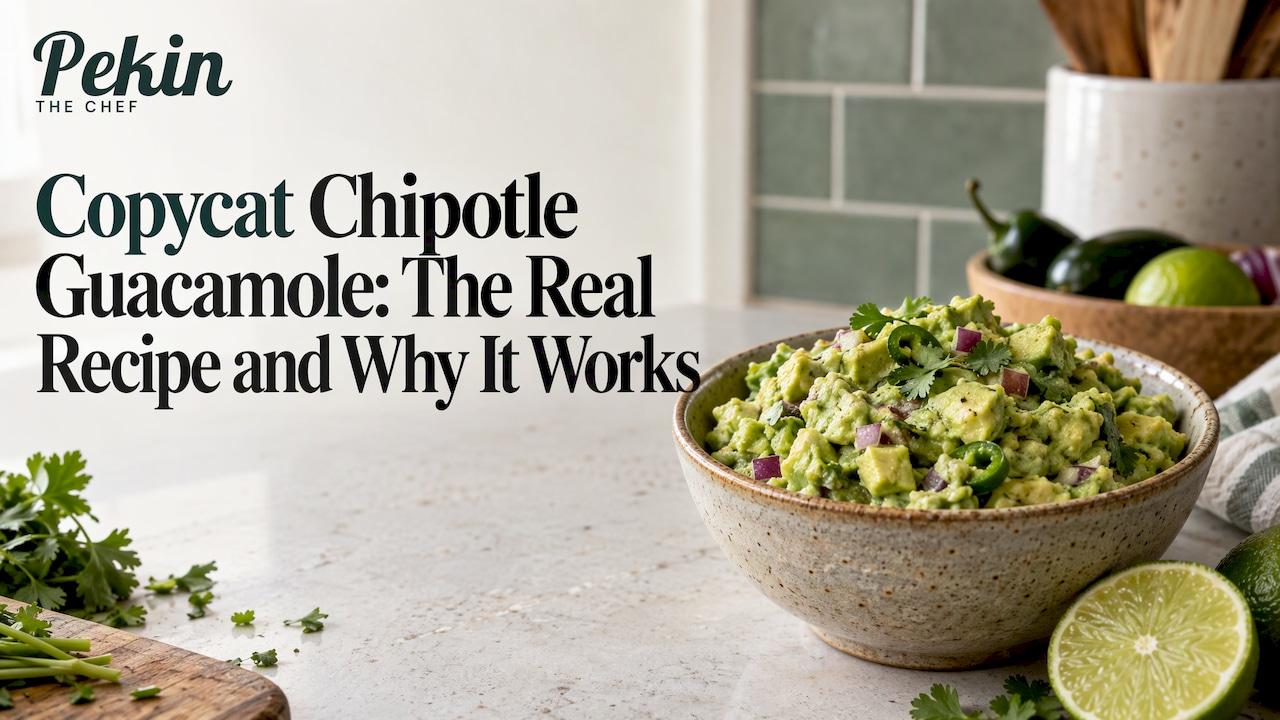
The best copycat Chipotle guacamole is also the simplest: ripe Hass avocados, lime, cilantro, red onion, jalapeño and kosher salt, mashed so it stays chunky. Chipotle publishes its own home version, so there is no secret spice to chase. What separates a good bowl from a great one is the avocado you start with, how lightly you mash it, and how you season it. Below you will find the exact amounts, a scaled-up batch for a family, fixes for heat and browning, and a short guide to a copycat barbacoa, the filling most people want to pile it onto.
TL;DR
- Chipotle's published recipe uses 2 ripe Hass avocados, 2 teaspoons lime juice, 2 tablespoons chopped cilantro, 1/4 cup finely chopped red onion, 1/2 jalapeño with seeds, and 1/4 teaspoon kosher salt.
- Ripeness matters more than any ingredient: a fruit that yields to gentle pressure gives the creamy-but-chunky texture.
- Mash with a fork, fold in the rest, and taste before you serve. Salt and lime do most of the work.
- Press plastic wrap directly onto the surface to slow browning.
- Copycat barbacoa is a low-and-slow braise of beef chuck in chipotle and adobo, ready in roughly 3 to 3½ hours on the stove or in the oven.
Table of Contents
- What Chipotle Actually Puts in Its Guacamole
- How to Make It, Step by Step
- Choosing Avocados That Make the Difference
- Adjusting Heat, Salt and Texture
- Scaling Up for a Family or a Party
- Keeping Guacamole Green
- What to Serve It With
- Copycat Chipotle Barbacoa: The Filling Worth Pairing
- Our Perspective
- Explore More Restaurant-Inspired Recipes
- FAQ
- Sources
What Chipotle Actually Puts in Its Guacamole
There is something quietly admirable about a dip that refuses to hide behind a long ingredient list. Chipotle's guacamole is made from ripe Hass avocados, salt, lime juice, cilantro, finely chopped red onion and jalapeño, according to the chain's own recipe page. Nothing else: no sour cream, no mayonnaise, no garlic powder, no tomato.
That is why the "what is the secret?" question has such an unglamorous answer. The restaurant starts with 48 whole, ripe avocados per batch and makes it fresh throughout the day. The flavor you remember is avocado at its peak, brightened by acid and sharpened by raw onion and chile. The craft lies in the details, and the details are all things a home cook can control.

The home-scale recipe
This is the amount Chipotle publishes for home cooks, and it makes roughly a generous bowl for two to four people as a side or topping.
| Ingredient | Amount |
|---|---|
| Ripe Hass avocados | 2 |
| Fresh lime juice | 2 teaspoons |
| Fresh cilantro, chopped | 2 tablespoons |
| Red onion, finely chopped | 1/4 cup |
| Jalapeño, finely chopped, seeds included | 1/2 |
| Kosher salt | 1/4 teaspoon |
The jalapeño is used with its seeds, which is where much of the heat lives. If you are cooking for children or anyone who prefers mild food, you will find an easy adjustment further down.
How to Make It, Step by Step
The method takes about five minutes, but each step has a spot where a bowl quietly goes wrong. Here is what to watch.
- Prep the aromatics first. Chop the red onion finely and the jalapeño just as finely, so no one bites into a large raw chunk. Chop the cilantro, leaves and tender stems together. Doing this before you cut the avocados means the fruit is exposed to air for as little time as possible.
- Halve and pit the avocados. Cut around the pit lengthwise, twist the halves apart, and tap the pit with the heel of a knife to lift it out. Scoop the flesh into a bowl with a large spoon.
- Add the lime juice and salt right away. The acid brightens the flavor and helps keep the green color. The salt seasons the avocado itself, which is bland without it.
- Mash with a fork, not a blender. Press and fold until about two thirds of the avocado is creamy and the rest remains in small chunks. This contrast is the signature texture of the restaurant version. A food processor will turn it into a smooth spread.
- Fold in the onion, jalapeño and cilantro. Use a spatula and stir only until combined. Overmixing breaks down the chunks you worked to keep.
- Taste with a chip. Salt changes how a dip tastes on a chip compared with a spoon, so test it the way you will eat it. Add a pinch of salt or a few drops of lime until it tastes lively rather than flat.
If you like to compare how restaurants build their own versions, we have recipes inspired by Agave 137 Tequila Bar & Kitchen's guacamole and Ahora Mexican Restaurant's chips y guacamole, each with its own twist on the same foundation.
Choosing Avocados That Make the Difference
The single most common reason a copycat guacamole disappoints is under-ripe fruit. Hard avocados mash into a pale, waxy paste with little flavor, no matter how good your seasoning is.
Reading ripeness
Hass avocados darken from bright green to a deep purplish-black as they ripen, but color is only a first clue. Cradle the fruit in your palm and squeeze very gently: a ripe avocado yields slightly without feeling mushy. Avoid pressing with your fingertips, which bruises the flesh. Flicking off the small stem cap is another check: green underneath usually means ready, brown means overripe.

Timing your shopping
If you buy avocados the day you plan to cook, they will almost certainly be firm. Buy two to three days ahead and leave them on the counter. When they are close, move them to the refrigerator to hold them at that stage for a day or so. Buying one extra avocado gives you insurance in case one turns out disappointing inside.
Cilantro, onion and jalapeño
Choose firm red onion with no soft spots, since its crisp bite is part of the contrast with the creamy avocado. Look for a jalapeño with smooth, glossy skin. Fresh lime juice is worth squeezing yourself: the bottled kind tastes flatter, and with only 2 teaspoons in the recipe, one lime is plenty.
Adjusting Heat, Salt and Texture
One reason people love the Chipotle version is that it is balanced rather than aggressive. The published ratio is a starting point, and you can tune it to your table.
- Milder: Remove the seeds and white ribs from the jalapeño, and use a little less. You keep the grassy flavor but lose most of the burn.
- Spicier: Keep the seeds and add a few extra slices of jalapeño, or mince a small piece of a second one.
- Sharper onion flavor without the sting: Rinse the chopped onion briefly under cold water and pat it dry before folding it in.
- Smoother: Mash a little longer, but stop before it turns into a puree. For children who dislike chunks, mash half the batch thoroughly and fold the aromatics into that.
- Brighter: Add lime a few drops at a time. It is easy to add acid and impossible to take it back out.
Kosher salt has larger flakes than table salt, so if you only have table salt, start with a smaller pinch and build up. Taste, adjust, taste again.
Scaling Up for a Family or a Party
The recipe multiplies cleanly, because it is built on a simple ratio. For a bowl that feeds a crowd, here is a worked example for three times the base amount:
| Ingredient | Triple batch |
|---|---|
| Ripe Hass avocados | 6 |
| Fresh lime juice | 2 tablespoons (6 teaspoons) |
| Fresh cilantro, chopped | 6 tablespoons |
| Red onion, finely chopped | 3/4 cup |
| Jalapeño, finely chopped, with seeds | 1 1/2 |
| Kosher salt | 3/4 teaspoon |
When you scale up, season in stages. Start with two thirds of the salt and lime, taste, then add more. Larger quantities of avocado can need a slightly higher proportion of salt than the straight multiplication suggests, and tasting is more reliable than arithmetic.
Keeping Guacamole Green
Avocado browns because the cut flesh reacts with oxygen. You cannot stop it entirely, but you can slow it a good deal.
- Press wrap on the surface. Smooth the guacamole flat, then lay plastic wrap directly against it, pushing out any air pockets. Covering the bowl with a loose lid is far less effective than contact.
- Use an airtight container. If you are storing leftovers, pick a container sized to the amount you have, so there is little empty space above.
- Make it close to serving. Guacamole is best within a few hours. If you must prepare ahead, mash and season, cover tightly, and refrigerate.
- Stir before serving. If a thin darker layer has formed, scrape or stir it in. The flesh underneath is typically still fresh and green.
Ample lime juice helps too, but adding much more than the recipe calls for changes the flavor, so lean on the wrap rather than on extra acid.
What to Serve It With
Chips are the obvious partner, and a simple bowl of warm, salted tortilla chips lets the guacamole be the star. Beyond the chip bowl, this guacamole is the natural companion to burritos, bowls, tacos and nachos. For ideas on what to put on the table around it, from salsas to crunchy toppings, this guide to taco toppings and sides is a good place to browse.
If you want a smoky, chile-forward partner, try the filling in 10 Acres Commons' chipotle and citrus chicken tacos, where cool guacamole against warm spice is exactly the point.
Copycat Chipotle Barbacoa: The Filling Worth Pairing
Many cooks searching for the guacamole also want the barbacoa, since the two end up together in the same burrito bowl. Barbacoa traditionally meant meat cooked slowly for hours until it falls apart. The home version below follows that spirit with a chipotle-and-adobo braise. It is a technique guide built on standard braising principles, not a claim about the restaurant's exact formula.
Which cut to choose
Beef chuck roast is the dependable choice. It has plenty of connective tissue and fat, which melt over a long cook and turn the meat tender and juicy. Lean cuts dry out. Look for a roast of about 3 pounds with good marbling.
The flavor base
Blend or finely mince together:
- 2 to 3 chipotle peppers in adobo, plus a spoonful or two of the sauce
- 4 cloves of garlic
- 1 tablespoon ground cumin
- 1 tablespoon dried oregano
- A pinch of ground cloves
- 2 tablespoons apple cider vinegar or the juice of 2 limes
- A few bay leaves, black pepper and kosher salt
Chipotle peppers in adobo are smoked jalapeños packed in a tangy red sauce, sold in small cans in the international or Mexican aisle. They are quite hot, so begin with two peppers and add more only if you want extra fire.
Method
- Cut and season. Trim the roast of any large fat caps and cut it into 3 or 4 big chunks. Salt generously.
- Sear. Brown the pieces in a heavy pot with a little oil over medium-high heat, about 4 to 5 minutes per side. This builds the deep savory crust.
- Add the paste and liquid. Coat the meat in the blended flavor base, tuck in the bay leaves, and pour in about 1/2 cup of beef broth or water.
- Braise low and slow. Cover and cook in a 300°F oven or on a very low simmer for roughly 3 to 3½ hours, turning the meat once or twice, until it shreds with a fork.
- Shred and moisten. Pull the beef apart and stir it into the pot juices. Skim excess fat if you like, then taste for salt and acid.
Slow cooker or pressure cooker
For a slow cooker, sear the meat first if you can, then cook on low for about 8 to 10 hours or on high for 4 to 6. A pressure cooker shortens the process considerably; follow your appliance's manual for timing and liquid minimums. In every method, the test is the same: the meat should yield to a fork with no resistance.
Serving
Spoon the shredded barbacoa into warm tortillas, over rice and beans, or into a burrito, then top with your fresh guacamole. The creamy dip cools the smoky heat, which is exactly why the pairing works.
Our Perspective
A copycat recipe earns its place when it tells you why each ingredient is there. Chipotle's guacamole shows how much a dish can gain from restraint: six ingredients, each doing a clear job, with the avocado carrying the whole thing.
That is the idea behind everything we publish at Pek in the Chef. Our recipes are inspired by dishes from real restaurants, and each one comes with feedback from other home cooks, so you can see how it turned out in kitchens like yours before you shop and cook. When a dish is as simple as guacamole, those small notes, a little less jalapeño here, an extra squeeze of lime there, are exactly what turn a good result into one you will repeat.
We also like to organize things the way you actually search: by restaurant, dish, cuisine, meal type and prep time. Whether you want a five-minute dip or a slow-braised weekend project, the next idea is easy to find, and there is always something new to try.
Rhys
Explore More Restaurant-Inspired Recipes
If this guacamole has you wanting to recreate more of your favorite restaurant dishes, our collection is built for exactly that. Browse recipes inspired by popular restaurants, filter by cuisine or prep time, and read what other home cooks think before you start. You will find dips, mains, drinks and desserts, all in one place at Pek in the Chef.

For a different style of avocado dish, try the smashed avocado toast inspired by Acre, or look up a restaurant you love by name and see what is waiting.
FAQ
What does Chipotle use in its guacamole?
Chipotle's guacamole is made from ripe Hass avocados, salt, lime juice, cilantro, finely chopped red onion and jalapeño. Its published home recipe lists those same six ingredients with exact amounts. There are no extras such as garlic or tomato.
What makes Chipotle guac so good?
The flavor comes from very ripe avocados, fresh lime and salt, and from a chunky texture rather than a smooth puree. The restaurant starts each batch with 48 whole avocados and makes it fresh through the day. At home, choosing ripe fruit and mashing lightly gets you most of the way there.
How do I keep copycat guacamole from turning brown?
Press plastic wrap directly onto the surface so no air touches it, and store it in a snug, airtight container in the refrigerator. Add the lime juice when you mash. Serve it as close to mealtime as you can, and stir in any thin darker layer before serving.
How long does copycat barbacoa take?
On the stove or in a 300°F oven, beef chuck usually needs about 3 to 3½ hours at a gentle heat until it shreds easily. A slow cooker takes about 8 to 10 hours on low. Judge doneness by texture: the meat should fall apart with a fork.